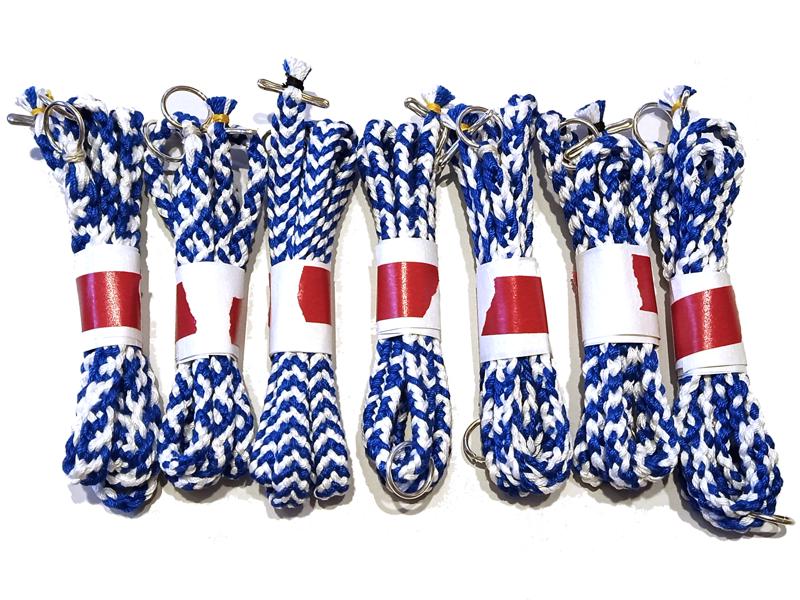
I completed these braids back in November or December, but I was holding off posting about them because I was going to put them in the Coronation gift basket in April. Then, I found out there was a largesse display at Baronial 12th Night.
6 16-strand “Double Rai” braids in red and white
They are all color variations on the same braid, with 8 red and 8 white strands per braid. The effects of the different starting positions produce end results that are similar to those produced for other 16-strand braids that are doubles of 8-strand braids.
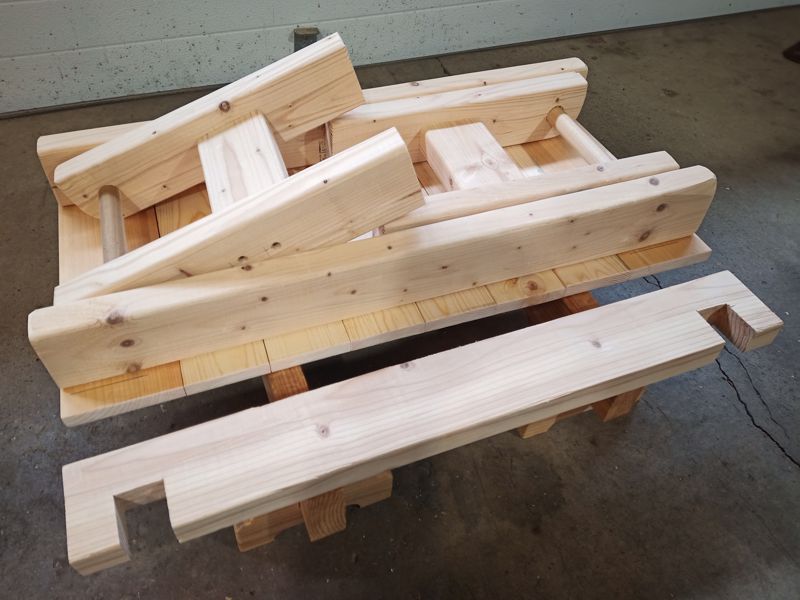
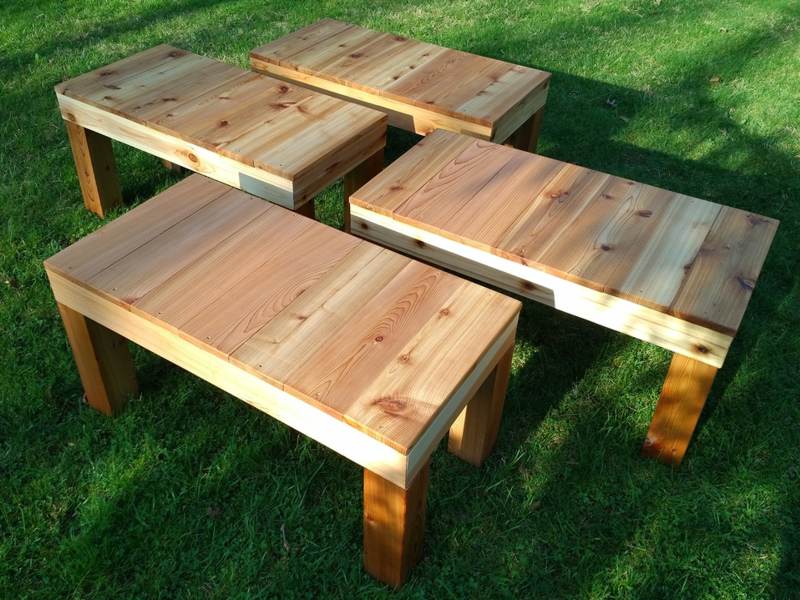
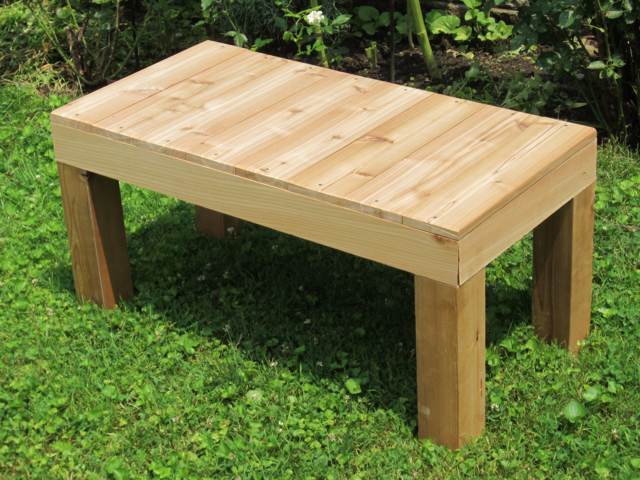
We are going to need some auxiliary seating at an SCA event in March, and most of the benches I havemade are locked up in a storage trailer. Plus, they are large and not very portable. My breakdown bench is nice and portable, but somewhat of a pain to re-create given the weird joinery. I decided to design something based on the shape of a Japanese endai bench, but a little smaller than normal, and with folding legs so that it be a little more portable. Bonus points if I could make it so that it would fit in a little fold-up wagon we use to transport stuff at events.
The endai with folding legs
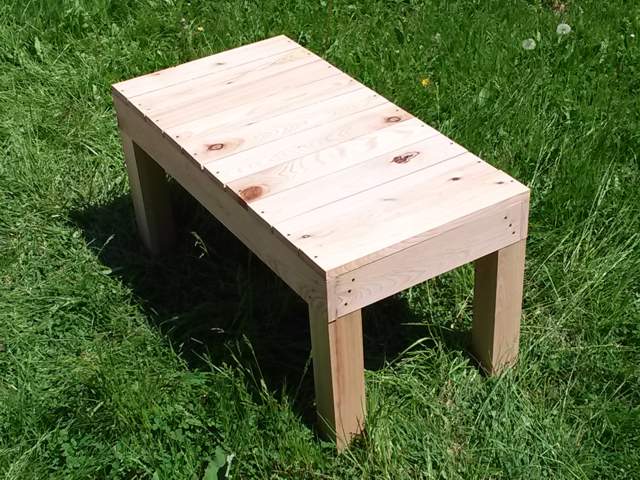
The top of this bench measures 15″x30″ and it is about 15″ tall. It took me most of a Saturday in the shop from start to finish. I was able to construct it entirely from lumber that I already had in the garage. The majority of the 2by4 material came from a single 12-footer that’s been up on the rack for three or four years. As a consequence, the bench has a bit of a twist to it and doesn’t sit completely flat on the floor until you put some weight on it. Even the axles for the legs are made from a poplar dowel I had “in stock”.
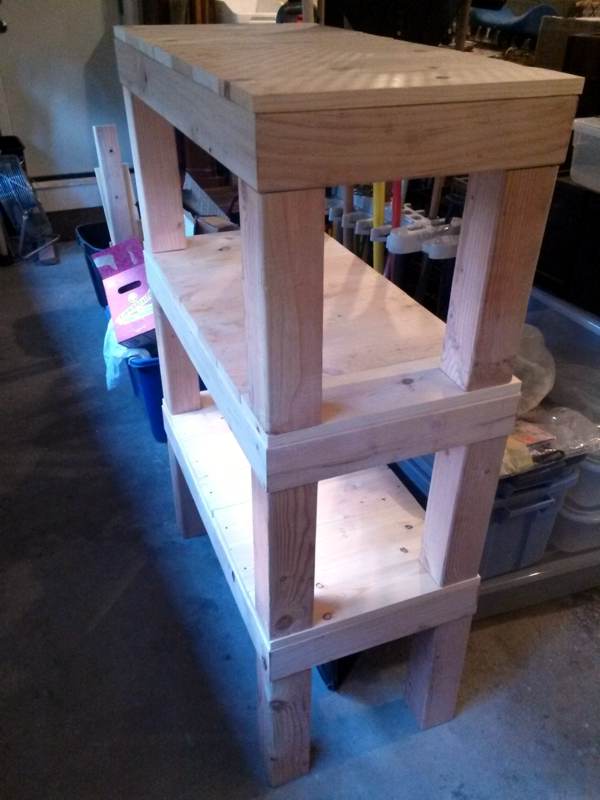
The endai with folded legs
Late in the design process, I decided to move the legs in one inch from the ends. I did not think about the fact that this would mean that the legs would have to be shorter if they were going to fold entirely into the undercarriage. So, it does not fold up entirely, but it does fold up mostly. If I cut the legs an inch shorter, they would fit, but I also would have to cut clearance curves onto the ends so that the corners wouldn’t jam things up.
I used screws to hold the whole thing together, which I’m not proud of, but I just was not in the mood to do fancier joinery than that. I am proud of the fact that I did most of the cutting by hand with a ryoba saw, though the curves at the tops of the legs were much easier on the band saw. The sanding and assembly were all done with power tools, because I really did want this to be done in one day. Success!
We visited my family in NJ at the end of 2022, and took a little field trip to the Thomas A. Edison memorial park that is located where Edison’s original labs were, in what is now Edison Township.
A second braid made on the takadai. This one is a 33-tama 2/2 twill braid made with four plies of reeled silk yarn per strand. 16 strands are rose pink, and 17 strands are scarlet. I started with twice the length of material as last time, and wound up with about 6 feet of braid.
Silk 2/2 Twill Takadai Braid, ~2 yards
Because I used reeled silk instead of plied silk yarn, the braid came out much smoother, flatter, and even than the first braid. The takdai does a lot of the work, of course, keeping the tension even and such, but I am really happy with this braid.
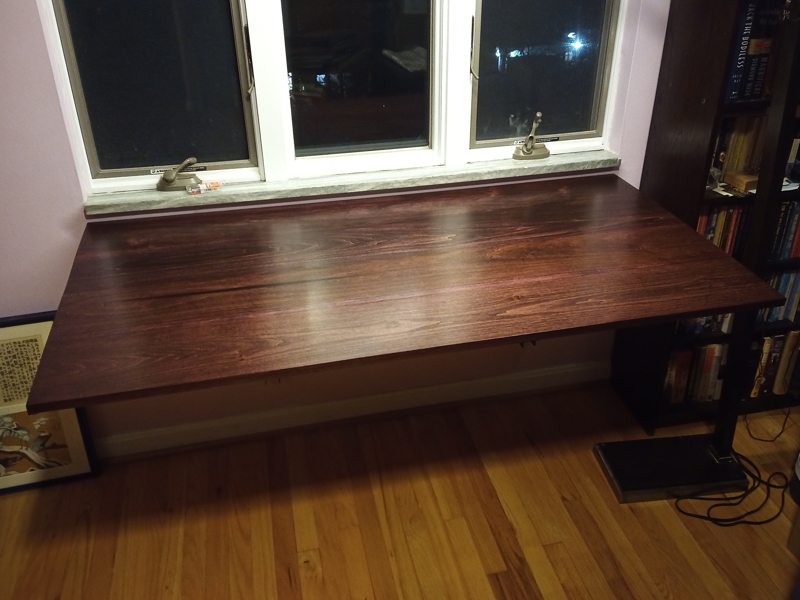
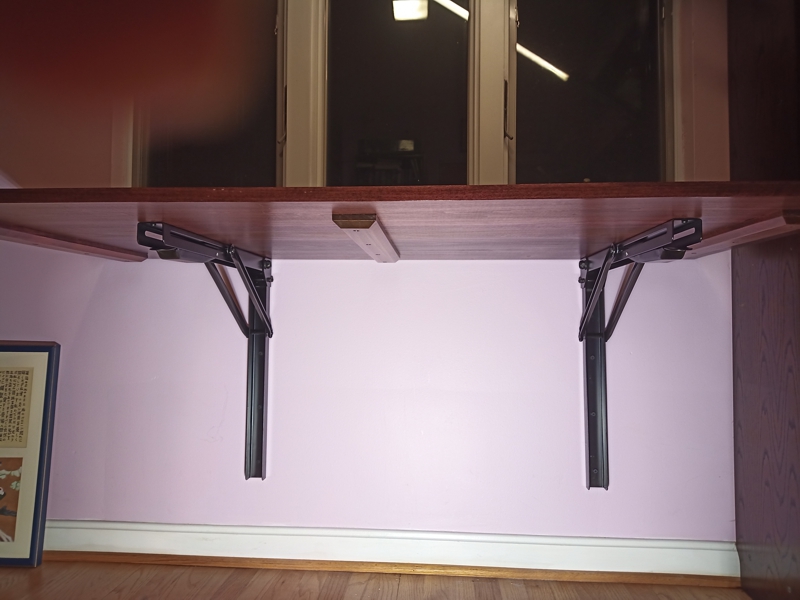
Back in December, we installed a murphy bed in the guest bedroom. The room is kind of small, so the guest bed was taking up most of the floor space in the room. A murphy bed leaves more of the floor open when it is not being used. I saw some nifty-looking wall brackets in the Woodcraft, and these looked good to the landlady, so I went for it and decided to install a wall-mounted fold-down desk.
The desktop is actually four lengths of 1by8 that I edge-glued and doweled. Then, I cut the desktop to length, sanded, stained, sealed, and finished. After that, I just had to mount the brackets on the wall, and attach the desktop to the brackets. Easy peasy.
According to the takadai book that I have, the used takadai that I bought from a friend needs one more accessory to be complete. The raddle is used during set-up to keep the strands separated and in order before they are wound onto tama and placed on the koma. This takadai may not even have come with a raddle, since it is not 100% necessary for braiding. Having set up for two braids now, I can confirm it is optional. It does seem handy to have, though, so I decided to make one.
Takadai with Raddle
Thw raddle is the bar across the front of the takadai that is basically a row of pegs. I bought a piece of maple, and cut it down to the size I wanted. Then I drilled a line of 3/16″ holes along the length of the bar using the drill press, and rounded the top and side edges with a router.
Next, I cut a few 3/16″ diameter dowels into 1″ lengths. I rounded the ends of each peg with a Dremel grinding stone, and then glued one peg in each hole.
After attaching a couple of small blocks to the underside of the raddle so that it can be mounted in the slots of the outer arms, the raddle was ready to go.
Stuck in unmoving traffic on the Parkway East due to an incident on the Parkway West, I had this pleasant view of the 10th Street Bridge over Pittsburgh’s Monongahela River
All seven of these braids were made on the marudai using cotton crochet thread. I used four plies of thread per strand, four strands of green and four strands of black. The braids are a variety pack of 7 different braid shapes. All have ring and toggle closures and come with an extra jump ring so that they can be used as medallion cords. They are all approximately 30 inches long.
More catching up on projects I did months ago, here’s a banner I made for my friend Kieran MacRae. He changed his heraldry recently, and needed to rebuild his stock of tabards and banners from scratch. I decided to pitch in because I could.
Per pale and per chevron purpure and argent, a chevron counterchanged Or and sable
The fabric is some white linen I had in stock. The color is all “textile color” paint, which is more like a liquid pigment than the paint I normally use on linen. It soaks in and doesn’t change the hand of the fabric as much. It only works well on light fabric, though.