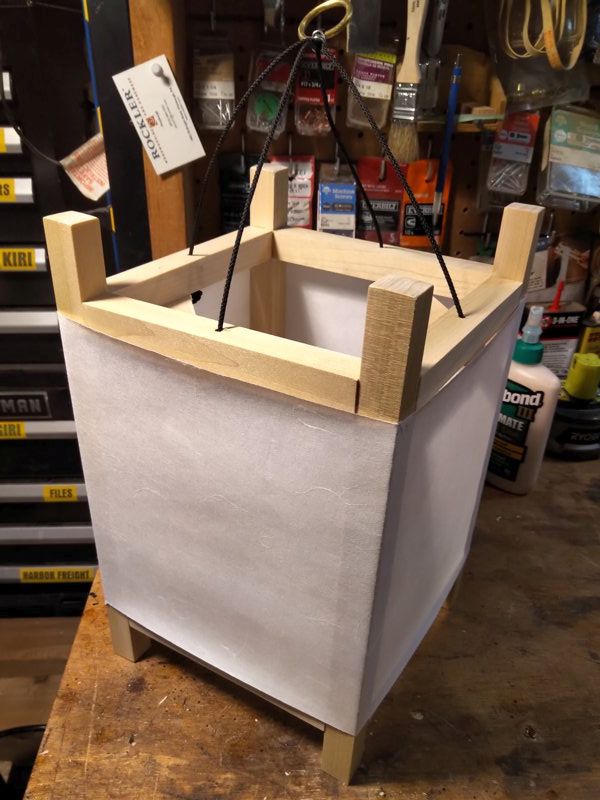
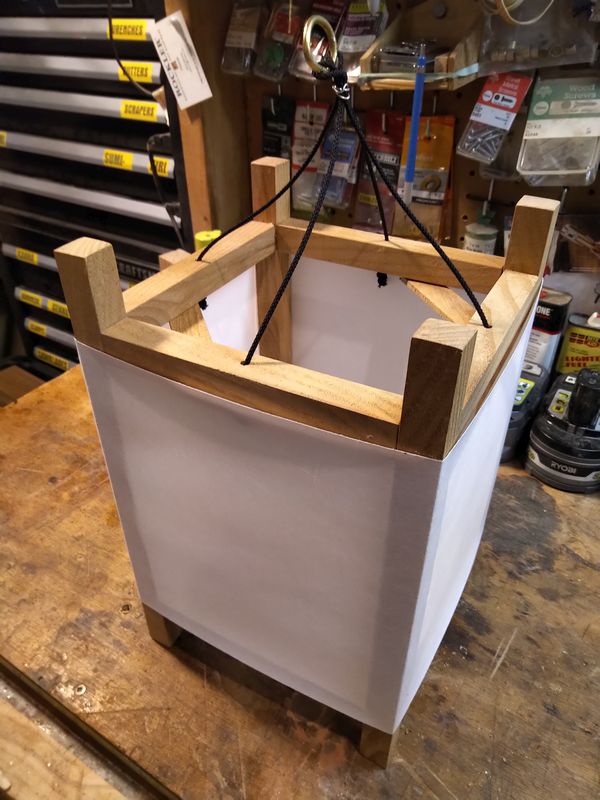
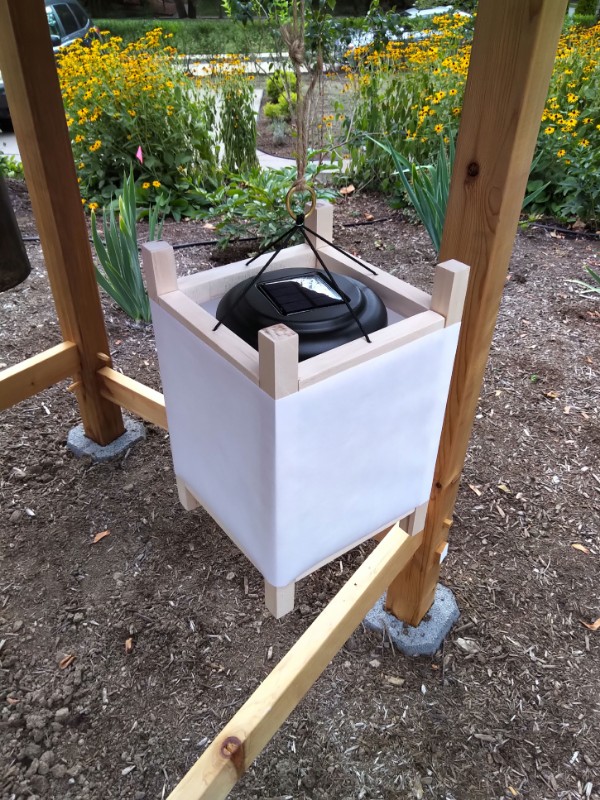
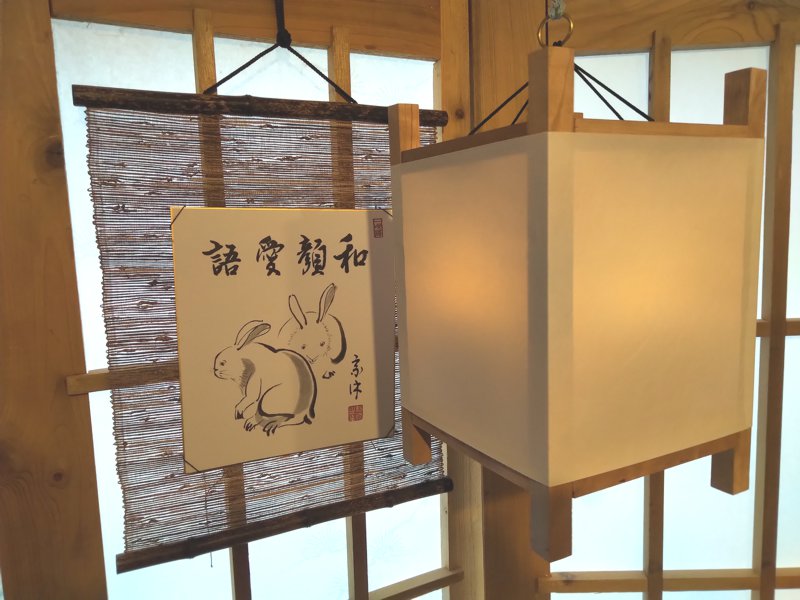
Progress on the wood frame lanterns to fit the solar flicker lighting units continues! I completed the fifth of six planned lanterns recently, this one made from some surplus poplar lumber I had in the garage.
Andon in Poplar
Here is the lantern hanging in the Shourou at night after a recent snowfall:
I started working on another lantern today, and I thought I’d show you how I use a Japanese kanna block plane to remove the marks left on the wood by the band saw that I use to mill the lumber into pieces. You can hear the vibration at first, that eventually gives way to smooth shaving noises.
I spin the piece around part way through so that the blade is cutting at an angle across the grain instead of into the grain. This yields a smoother cut. You can see that at the start, the grain lines are pointing up and to the right. Then, after the spin, they are pointing down and to the left.
You can also see that the piece I am planing is not clamped down at all. Since you’re pushing down on the plane, and so down on the piece, the only thing that’s necessary is the planing stop that you can see screwed down to the “planing beam”. My planing beam is simply a length of 2by4 held in my bench vise. My planing stop is 3 inches of 1/8″ welding iron that I drilled a couple of holes in so that I could screw it down. I did have to file the edge of the iron so that it wasn’t rounded over.
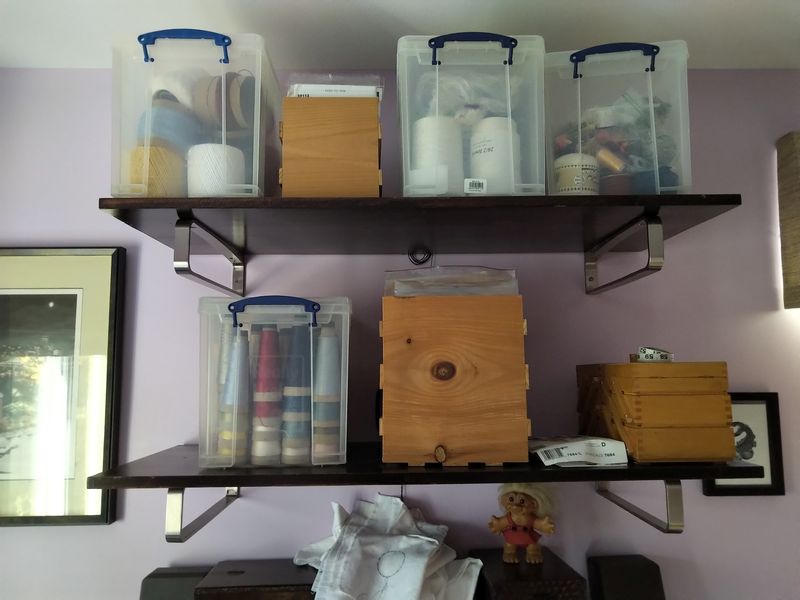
Back at the old house, we had six shelves in the guest/sewing room. They were made from edge-glued pine panels, stained with a water-based “rosewood” stain, and finished with water-based polyurethane. Here at the new house, we only needed two of them, so the other four shelves were in storage waiting for a good project.
Two Shelves
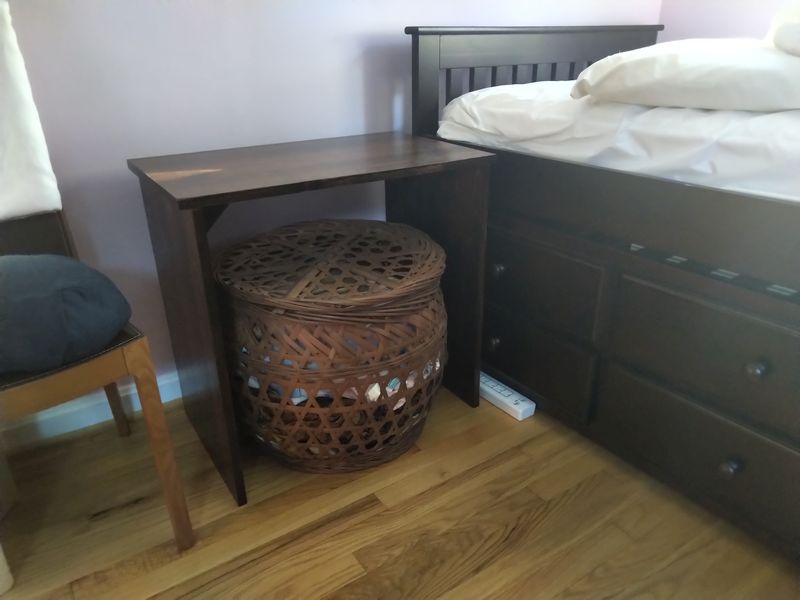
A few months ago, the Sweetie asked if I could make a bedside table for the guest room here at the new house. The only real requirements were that it matched the room furniture, and had enough space underneath to fit this hamper that also lives in the room.
Shelf Table
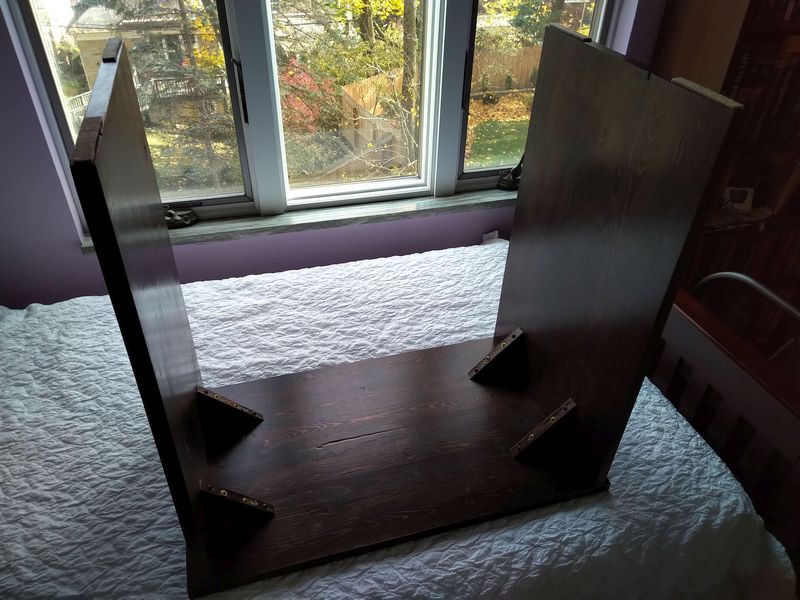
I took three of the surplus shelves, cut them to length, joined them with dowels, and glued them together. Of course, that was pretty-rickety. so I added some diagonal braces that I cut from one of the offcut pieces of shelf.
Underside of Shelf Table, showing bracing
Not very fancy, but it saved us a trip to the furniture box, and we know it matches the shelves!
I just completed another lantern for the “six lanterns” project. The frame of this one is made out of mulberry wood. I had a small plank of this that Mr. Arimoto gave to me probably about seven years ago, and it seemed like a good project to use it on.
Andon in Mulberry
Of course, with the paper on it like that, you can barely see any of the wood. The fibers in this plank were very rough and wavy, but in the places where my plane got a good shaving, the surface is super-nice.
Frame of Mulberry Andon
I rough-milled the sticks from the plank using my band saw, then hand planed them down to 3/4″ square rods. There really wasn’t enough wood in the plank to make it entirely from mulberry. To compensate, I made some of the stretchers a little shorter than normal, and used dowel joinery instead of my usual mortise and tenon joinery. This was a little easier, since it meant cutting short lengths of dowel instead of cutting 16 tenons, but it meant drilling twice as many mortises, half of them into the ends of stretchers. I could not have done it without my drill press.
Anybody who knows me well enough to read this here blog knows that I enjoy reading books by Neal Stephenson. Some people, including people I otherwise respect, consider him to be long-winded and tiresome. “Long-winded” I cannot argue against, but I find him to be endlessly entertaining.
DODO is 742 pages of epistolary diachronical action. It is chock full of manuscripts, emails, journal entries, after action reports, radio transcripts, running around, helicopters, car chases through the streets of Boston, boat rides, sex scenes, battles, beer drinking, quantum physics, holiday parties, and team meetings.
It took me more than a month to grind through it all, but I enjoyed the whole thing.
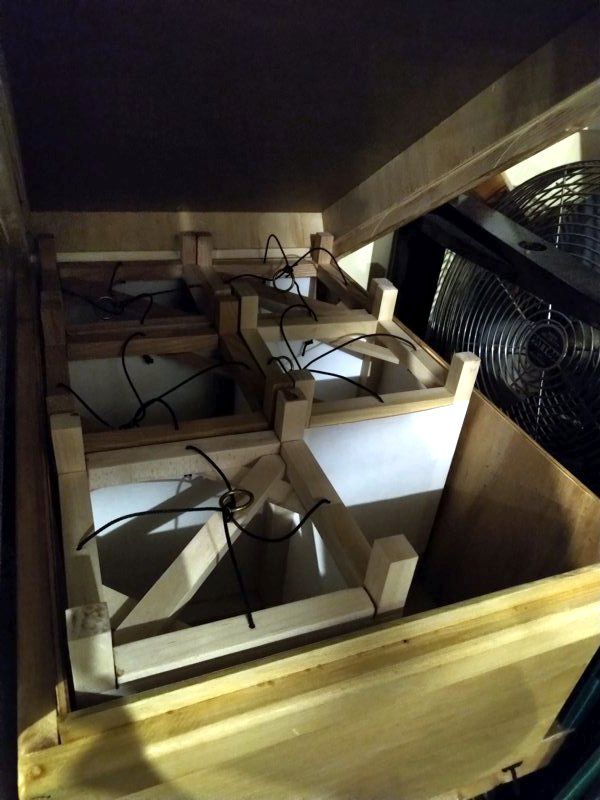
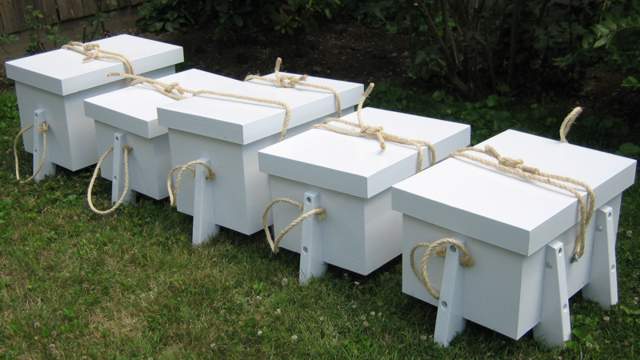
I’ve only made three of these lanterns so far, but I intend to make six, so eventually I will need something to transport and store them all in, or they are going to get pretty beat up. So, another box.
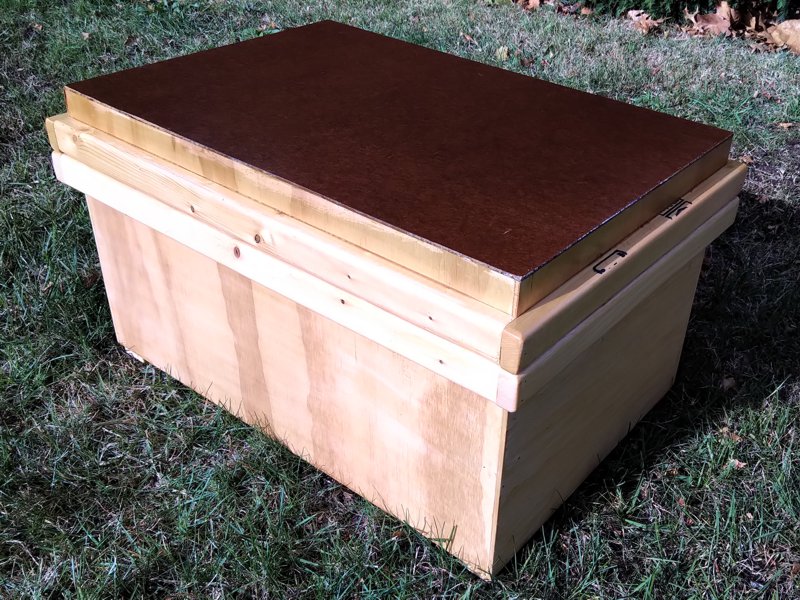
Lantern Box, Closed
This was also yet another exercise in using up surplus materials from other projects. I wound up having to use a piece of MDF for the lid, because that was the biggest piece of anything I had left. The edges are off-cut from 2-by-4 lumber from when I was making pole by cutting square pieces from 2-by-4. It awfully satisfying to use up some of that stuff.
Lantern Box, Open
You can see that the extra height of the lid makes it easy to get the lanterns in and out of the box. There’s an extra half inch in each direction, so the lanterns fit snugly but not tightly.
The whole thing is finished on the outside with spar polyurethane, especially the MDF on the lid, to give it a little more water resistance than a cardboard box. I glued some blocks of wood to the bottom to serve as feet, so it won’t be resting entirely in any puddles.
Basically, the whole thing is constructed with glue and nails form the nail gun. The bottom is thicker plywood to make it bottom-heavy, and the rim on the body both supports the lid and reinforces the corners of the box. This is a design and method I’ve used before with some success.
A lot of the sizing of pieces can be done while you’re building. For instance, I make the body of the box, then I measure the outside of the top before cutting the pieces for the lid. That way the lid is sized to fit the actual box, and not just my best hope.
The whole thing is kind of rough, because it’s not supposed to be anything special. You can see in the photos that I didn’t even sand off the mill markings.
We have a small propane-fueled grill that spends all summer out on the patio. Eventually, we decided that it wasn’t super cool to have a tank of propane just sitting out in the rain and sun, so I decided to build a storage box.
6-sided 3-leggad Storage Box for a Propane Tank
The box is mostly made from exterior-grade 3/8″ plywood. It’s hexagonal, which is more work, but actually uses less wood. I’m especially happy that I was able to keep track of all the pieces and their orientation, so the face grain of the plywood flows around the corners nicely.
The floor and lid of the box are 3/4″ plywood for durability. The edges of the lid are made from pine 1-by-4. Once you have the blade angled over to cut the 30 degree angle for the sides, you can use that angle for the lid edges, too. The 3 legs are pieces of 2-by-4 cut into my standard karabitsu leg shape on the band saw.
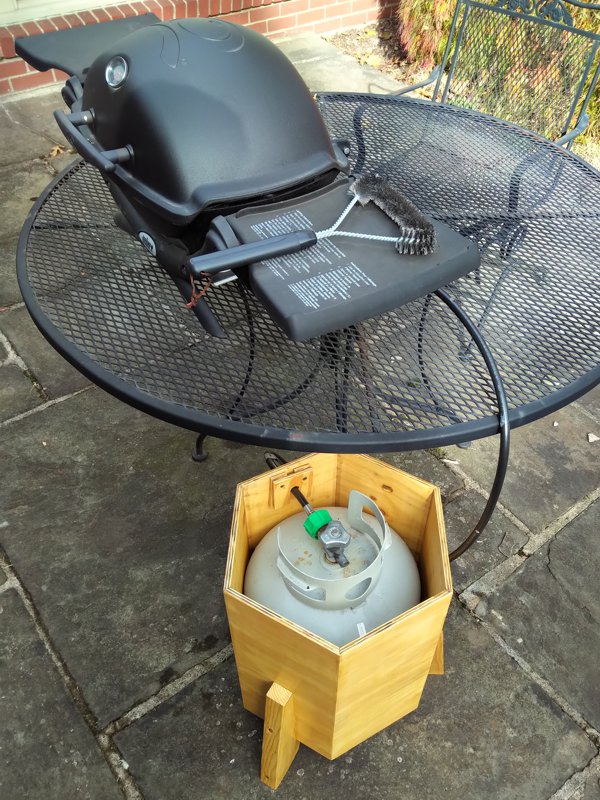
There is a large hole cut in one side of the box for the propane hose to pass through. A couple of smaller pieces inside block most of the hole and secure it once the tank is in place.
Open box showing the hose arrrangement
There are also some hols drilled in the bottom to allow any leaked propane to escape. I glued some nylon mesh over the holes to keep bugs from crawling inside.
The whole thing is finished in heavy-duty oil-based polyurethane. I had though about painting the box, but after I saw how interesting the grain was, clear satin it was.
A little closer up
It will also come in handy in the winter. We can clean up the grill itself and store it in the garage, but you really should not bring propane tanks inside like that. With the polyurethane I used, this thing can probably just sit outside on the patio all winter.
Having worked in two different industries where proprietary, custom-built, custom-programmed, programmable logic controllers (PLCs) were the order of the day, it is difficult for me to describe how accurate the name “Revolution” is for this product line.
Revolution Pi
Industrial controls based on open hardware and free software really do have the potential to change entire industries. I mean, they probably won’t, but they could.