Suprematism was an early twentieth century art movement that started in post-revolutionary Russia, and embodied the idea that humanity had to free itself from the past and move boldly into the future with new concepts of everything, including art. My personal attachment to Suprematism dates back just a few years to when my Aunt found a book about the city of Vitebsk.
In the early Soviet era, Vitebsk became a city-wide art colony. The Suprematist school was one of the largest and most influential schools of art in Vitebsk at that time. On one page of the book, there is a full-page photo of a delegation of artists from Vitebsk who are traveling to Moscow to lobby the government for increased arts funding. Right in the front of the crowd is a person who looks like he is a relative of mine, and the caption of the photo identifies him as having the same family name as my maternal grandmother. My guess is that he was probably a cousin of hers.
So anyway, that is the origin of my preoccupation with the Suprematist movement. There is way more to know about Suprematism than I am willing to include in this post. The nutshell version is that the Suprematists believed in the supremacy of geometric forms and subjective emotion over the functional objectivity of representational art. The most iconic painting is by Kazimir Malevich the founder of the Suprematist school, and it shows a large black square occupying the center of a square white canvas.
A couple of weeks ago, my mind presented me with an image that I recognized as a Suprematist composition. This image popped up daily from then on. From previous experiences with this kind of mental obsession I knew that only bringing this urge to physical form would get it out of my head. Yesterday, I finally walked to the art store, bought a canvas, and made it into an actual painting.
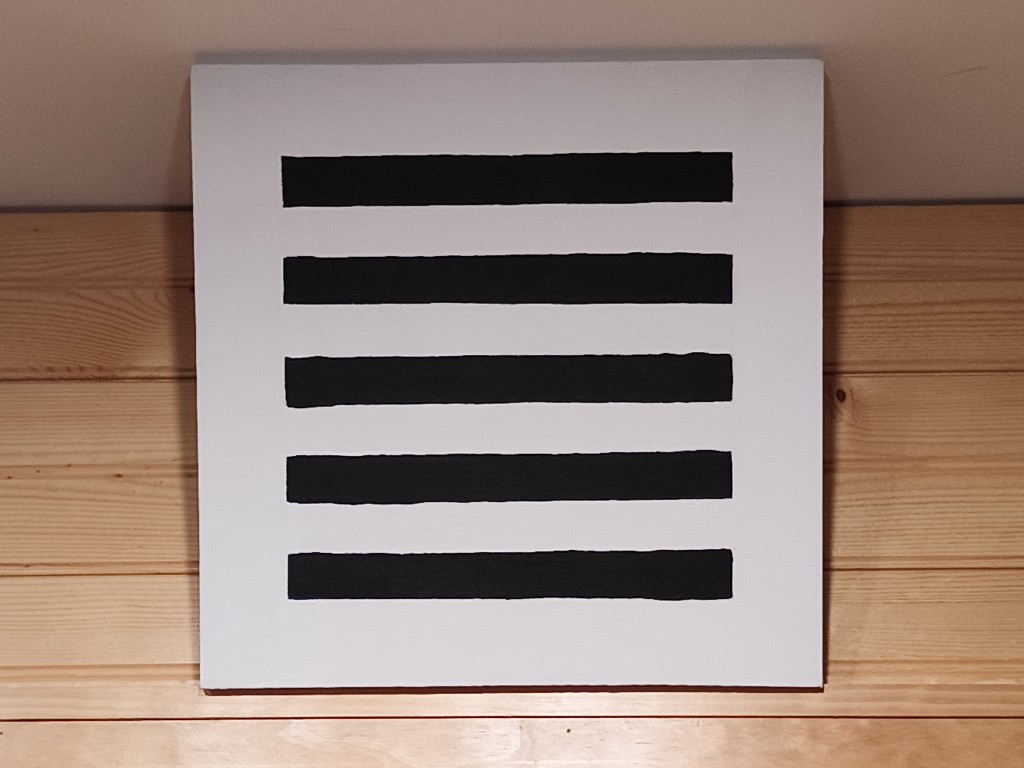
There it is, displayed in my home office as Malevich displayed his painting Black Square. It is one of the few projects I have ever produced that is a genuine attempt at artistic expression. You are, of course, entitled to your own opinions on “modern art” or my own clumsy execution. The composition was laid out by hand with ruler and pencil, and the paint applied to canvas by hand with brushes. This is not a joke of any kind. This composition has meaning to me, and this work has personal resonance.
A common criticism of abstract art is, “A child could have done this.” In this case at least I disagree. Not only was this work technically difficult to compose (Can you divide ten by nine using a ruler?) it relied on lengthy experience with brushes and paint to execute. A child who could do this should be sent to art school, engineering school, or both. Another criticism is, “I could have done this.” Again I disagree, because you did not. You did not have the combination of knowledge, emotion, history, experience, and desire that demanded the creation of this painting. If you have the basic skills necessary to replicate this painting (and I have no doubt that many of you who bother to read this far can exceed any rudimentary skills I have with paint) then by all means do so. If my painting inspires you to make your own painting in response, then I encourage — actually, I demand — that you do so. Even if your painting looks just like mine it will still be yours. Your painting will not be my painting.
I look forward to seeing your painting.