bookmark_borderSuprematist Composition #01

Suprematism was an early twentieth century art movement that started in post-revolutionary Russia, and embodied the idea that humanity had to free itself from the past and move boldly into the future with new concepts of everything, including art. My personal attachment to Suprematism dates back just a few years to when my Aunt found a book about the city of Vitebsk.

In the early Soviet era, Vitebsk became a city-wide art colony. The Suprematist school was one of the largest and most influential schools of art in Vitebsk at that time. On one page of the book, there is a full-page photo of a delegation of artists from Vitebsk who are traveling to Moscow to lobby the government for increased arts funding. Right in the front of the crowd is a person who looks like he is a relative of mine, and the caption of the photo identifies him as having the same family name as my maternal grandmother. My guess is that he was probably a cousin of hers.

So anyway, that is the origin of my preoccupation with the Suprematist movement. There is way more to know about Suprematism than I am willing to include in this post. The nutshell version is that the Suprematists believed in the supremacy of geometric forms and subjective emotion over the functional objectivity of representational art. The most iconic painting is by Kazimir Malevich the founder of the Suprematist school, and it shows a large black square occupying the center of a square white canvas.

A couple of weeks ago, my mind presented me with an image that I recognized as a Suprematist composition. This image popped up daily from then on. From previous experiences with this kind of mental obsession I knew that only bringing this urge to physical form would get it out of my head. Yesterday, I finally walked to the art store, bought a canvas, and made it into an actual painting.
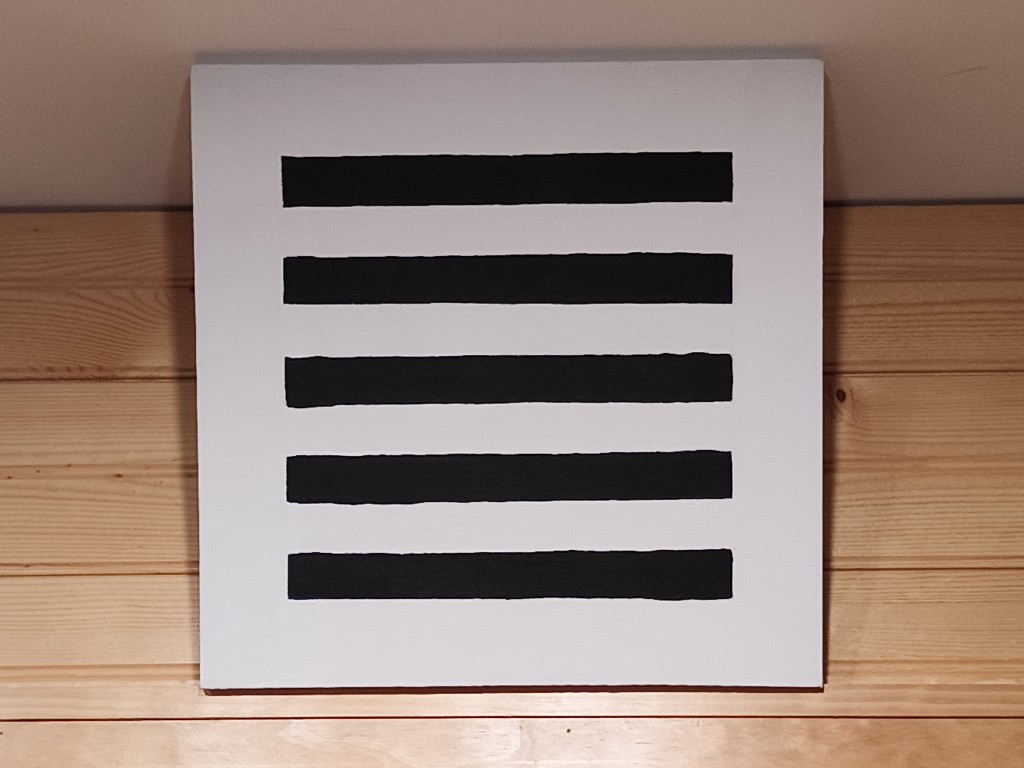
Five Black Bars (2026, Acrylic and Canvas, 14 in. by 14 in.)

There it is, displayed in my home office as Malevich displayed his painting Black Square. It is one of the few projects I have ever produced that is a genuine attempt at artistic expression. You are, of course, entitled to your own opinions on “modern art” or my own clumsy execution. The composition was laid out by hand with ruler and pencil, and the paint applied to canvas by hand with brushes. This is not a joke of any kind. This composition has meaning to me, and this work has personal resonance.

A common criticism of abstract art is, “A child could have done this.” In this case at least I disagree. Not only was this work technically difficult to compose (Can you divide ten by nine using a ruler?) it relied on lengthy experience with brushes and paint to execute. A child who could do this should be sent to art school, engineering school, or both. Another criticism is, “I could have done this.” Again I disagree, because you did not. You did not have the combination of knowledge, emotion, history, experience, and desire that demanded the creation of this painting. If you have the basic skills necessary to replicate this painting (and I have no doubt that many of you who bother to read this far can exceed any rudimentary skills I have with paint) then by all means do so. If my painting inspires you to make your own painting in response, then I encourage — actually, I demand — that you do so. Even if your painting looks just like mine it will still be yours. Your painting will not be my painting.

I look forward to seeing your painting.
bookmark_borderTool Roll for Pen-shaped Tools

A while back, I bought myself a pair of overalls. Sometimes, especially when it’s hot, wearing pants with a waistband is uncomfortable, and I usually have to wear a belt with pants, which makes it even more uncomfortable. These overalls had a couple of narrow tool slots on the thigh, and several more on the front bib. I took to carrying around markers, pencils, etcetera in these slots, then started acquiring more tools that were narrow enough to fit in them. Pen-knife! Penlight! Scissors! Soon I had more tools than I had slots, and some of my overalls (by now I was up to three pairs) had fewer slots. I needed a way to organize these tools in my dresser and maybe even pack them for travel. Time to make another tool roll. I went into my fabric stash and found a suitable piece of canvas left over from the Natural Shop Coat project, and got to work.

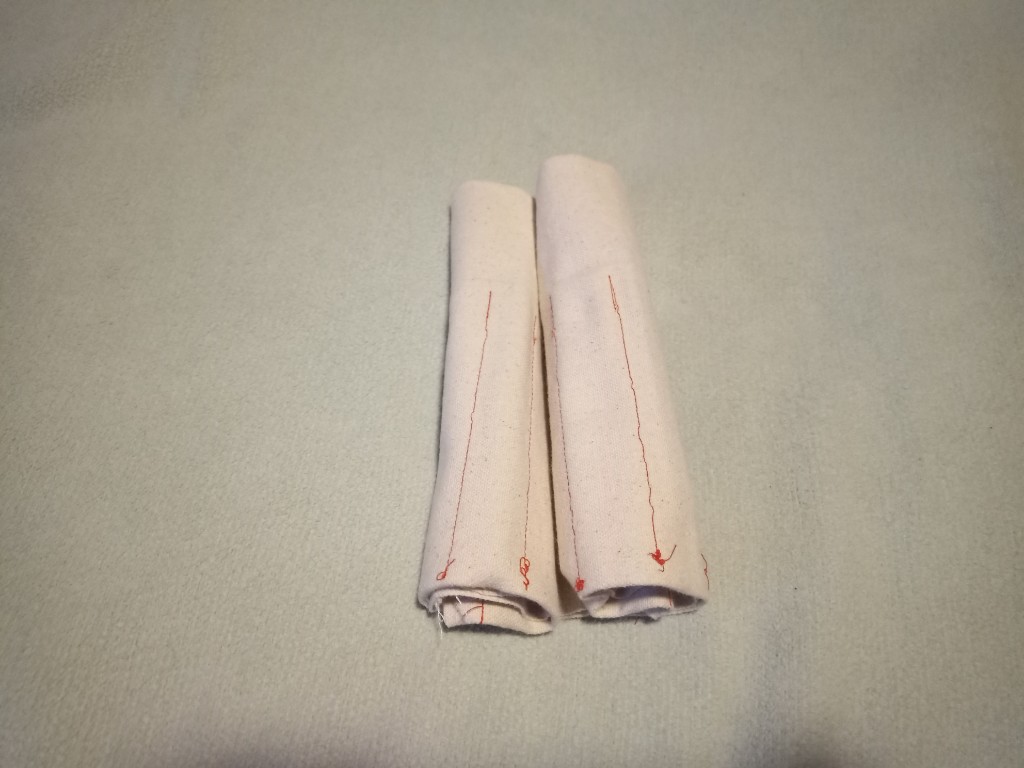
Tool Roll Closed

Here’s what it looks like all rolled up. You can see that I did not make any effort at all to hide the stitching. I don’t see why I would bother.

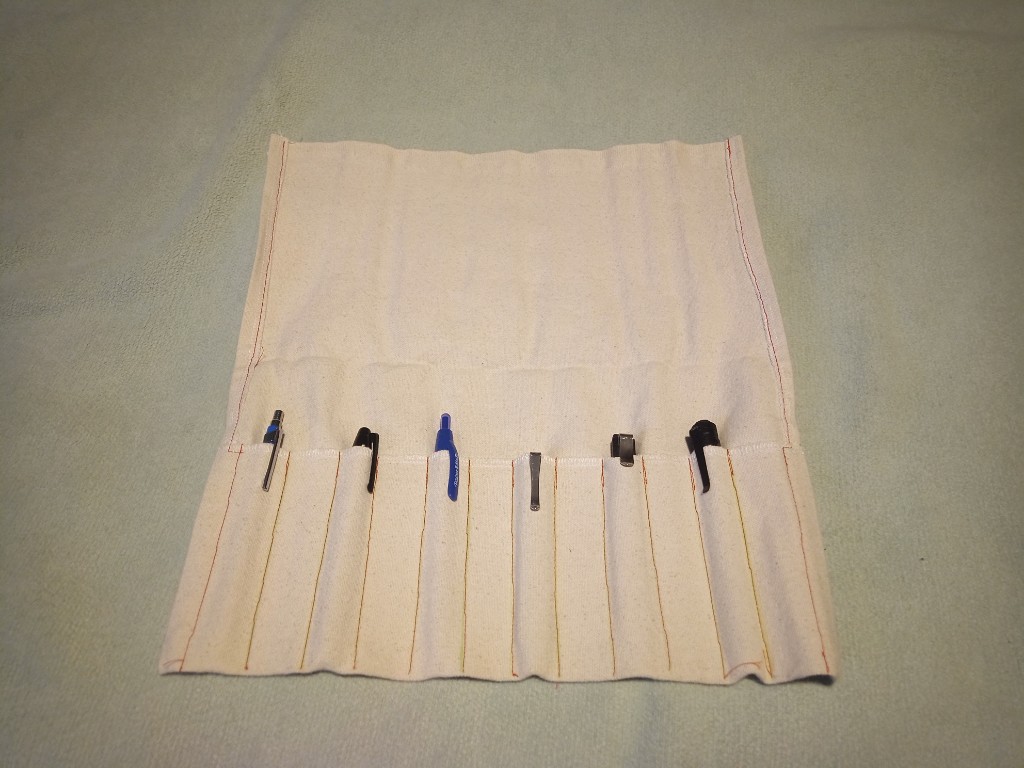
Tool Roll Open

Unroll it and lift the flap, and you can see six tools filling half of the twelve slots of the roll. I could also put a craft knife, metal ruler, screw driver, and some other things in there if I want. There’s even room if I acquire more tools. I think the rule is that the tool has to have a pocket clip. I had to add a pocket clip to the scissors so they would qualify.

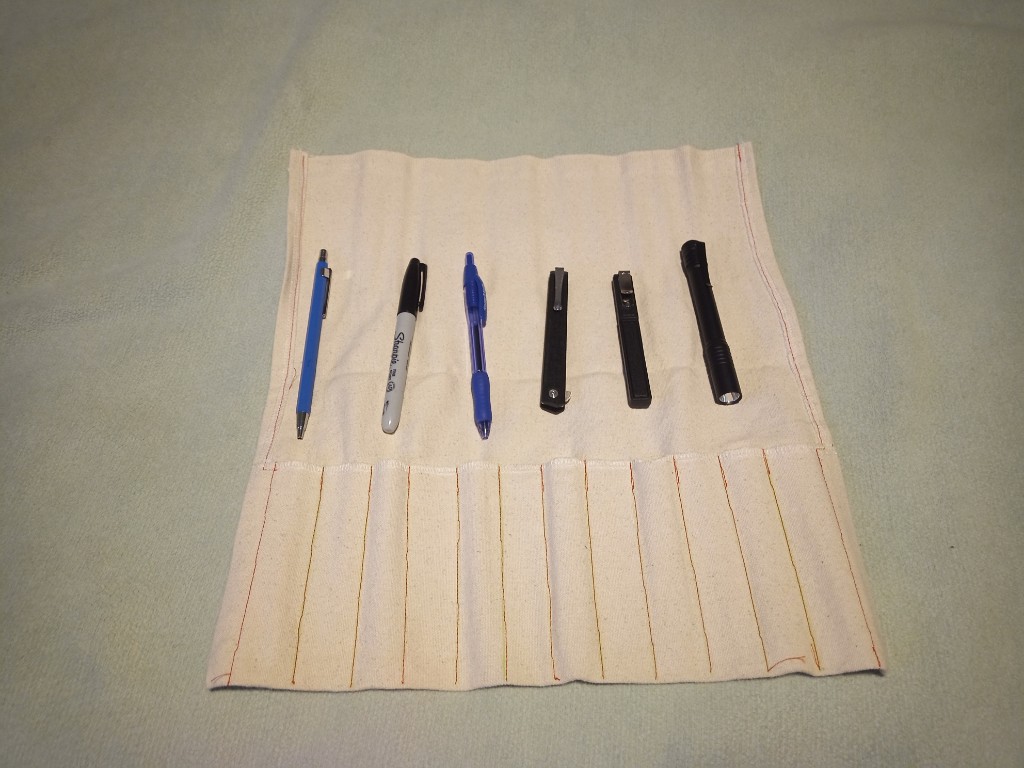
Tool Roll with Tools Shown

Here are all the tools I have in there right now: drafting pencil, marker, regular pen, folding knife, scissors. flashlight. See how handy this kit is?

bookmark_borderMaekake Aprons

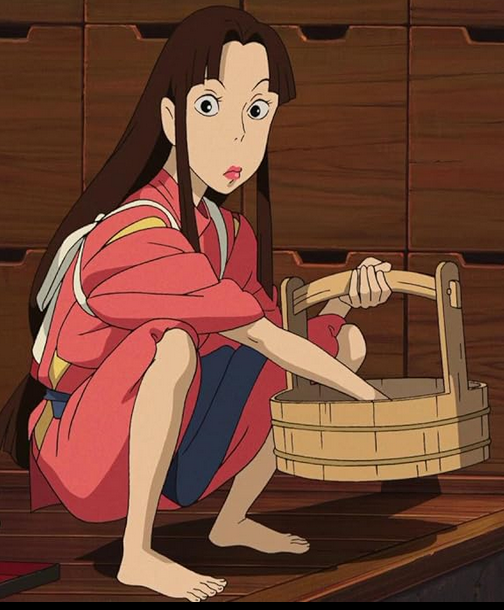
Back when I was making the Mizuoke based on this inspiration image from Spirited Away, my attention turned to the blue apron-type garment that Lin wears in the film.

There are better shots of it in the movie. There are even some scenes where she wears it tied around her neck as a kind of halter top. It turns out that this kind of apron is called a maekake, and it is basically just a length of indigo-dyed fabric with a waistband. These are common even today in Japan, where they are sometimes seen as a kind of folk art. They will often be printed with the name or logo of the business where the wearer works, so older ones will even be sold as antiques for that authentic decor accent. Modern ones often have art or promotional designs.

I went through my fabric stash, but I didn’t have a good piece of blue canvas or heavy linen. Instead, I picked some red and yellow canvas pieces. I had enough blue linen for the waist ties, though.

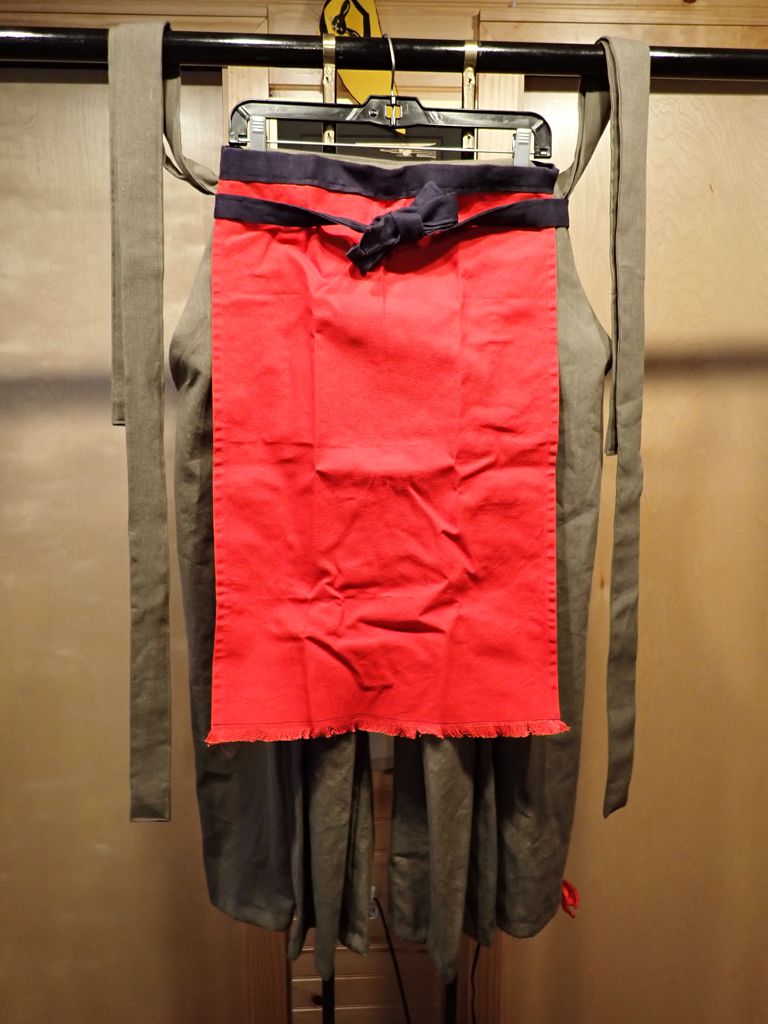
Red Maekake Apron, on Hakama
Yellow Maekake Apron, on Hakama

I hemmed the edges to simulate selvedges. The bottom edge would have just been left raw to make the fringe, but I decided to stitch across just above the fringe to keep it from fraying too much.

Red Maekake Apron, Flat
Yellow Maekake Apron, Flat

You can see that I did my standard 4-layer waistband. I made the ties about 3 yards long so that they can go around the waist twice and tie in front. The ones you can get today in Japan appear to have special fabric woven for the waist ties that is just doubled over instead of 4-layer. Hard to tell for sure.

Red Maekake Apron, Detail of Waistband
Yellow Maekake Apron, Detail of Fringe

I might eventually paint or stamp designs on these. An escarbuncle on the red one and a comet on the gold one might be fun. I will have to figure out a good placement.

bookmark_borderJapanese “Travel Coat”

I was watching the thoroughly inappropriate cut of the 2010 ridiculously entertaining Japanese action movie, “13 Assassins“, and while on the road, everybody had these great travel outfits. We go to a fair percentage of events where the event is primarily outdoors, and the weather turns out to be terrible. I figured that something like what they were wearing, only made to be waterproof and super-warm would be about the right thing to have in my wardrobe. Hence, the travel coat.

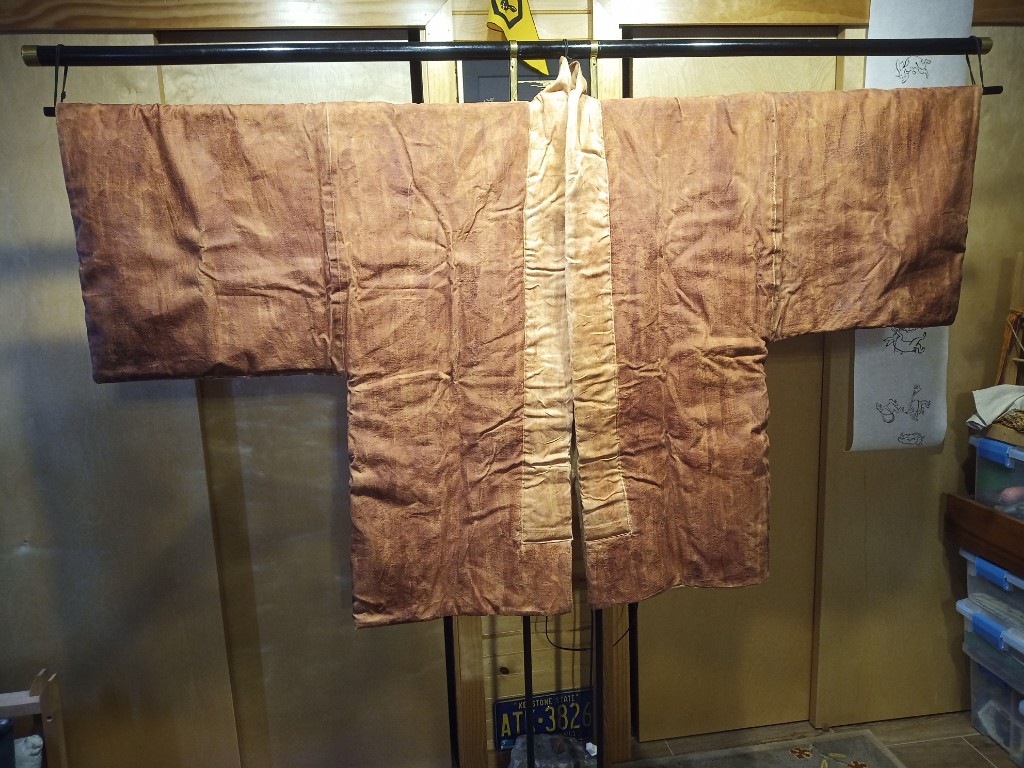
I made mine out of cotton canvas. It’s huge, with 18″-wide panels so it will fit over just about anything else I am likely to wear. I tried treating the canvas with kakishibu (fermented persimmon juice) to waterproof it, but it turns out you need many many coats of kakishibu to waterproof fabric, so I eventually sprayed it with a couple cans of waterproofing spray.

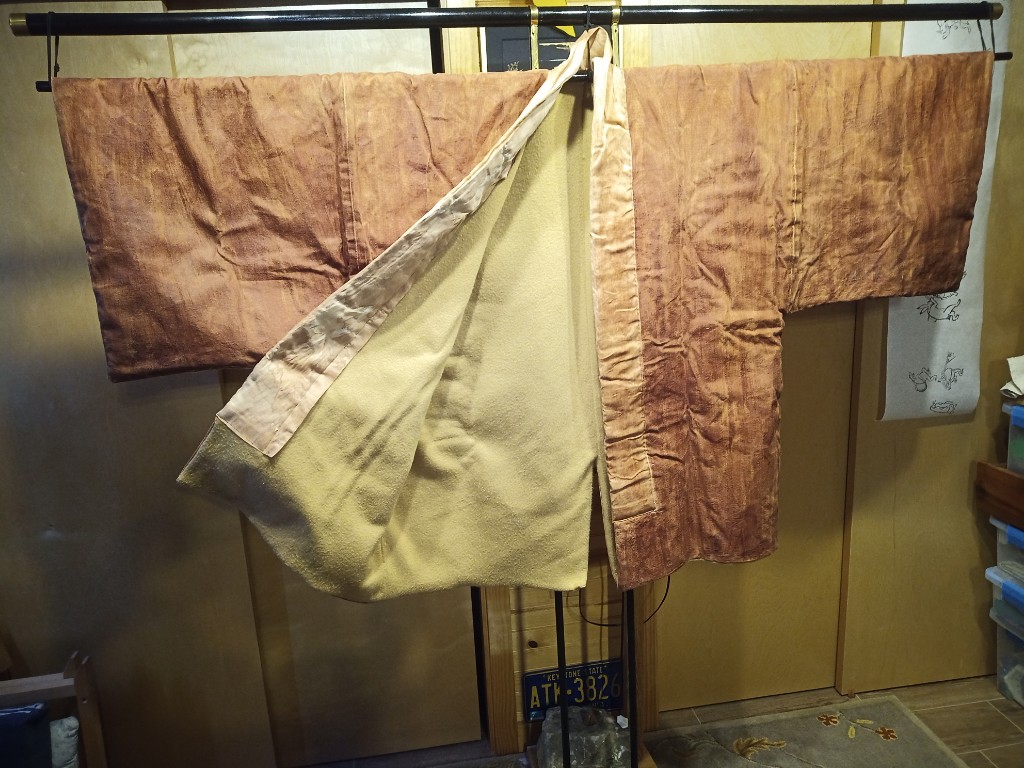
I lined the coat with poly-fleece fabric. Combined with the water resistant and windproof shell fabric, this is basically a bedspread with sleeves. I have not tried it in a driving snowstorm or downpour, but there was one damp, chilly night at Pennsic where I was awfully glad to have this with me.