bookmark_borderStill Braiding

I am still braiding with kumihimo on a regular basis, though not as much as I used to. Most of my braids become medallion cords that are donated to my local SCA group. Some become garb embellishments. every once in a while I just do a braid to practice a particular braid or color combination. Also, sometimes for fun. This one is basically for fun, to break up the monotony of making black&gold braids for the Barony or red&white braids for the Kingdom.
Completed 2021.10.31

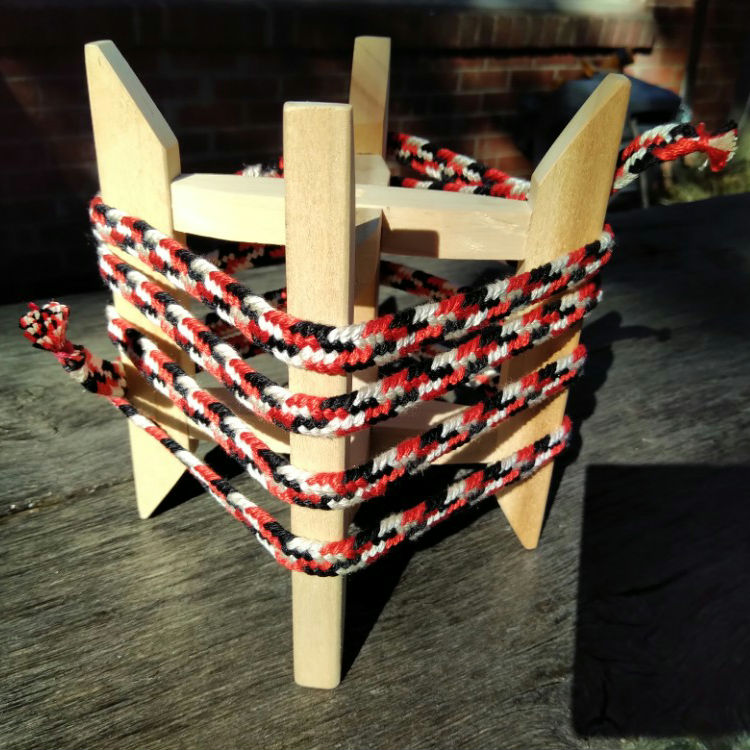
This braid is about 6 feet long. It is a 9-strand flat braid that uses 6 ends of lace-weight silk yarn per strand. This braid is a little short for it, but it is appropriate for use as a sageo or simply securing a box. To achieve this color pattern in the final braid, I started with a RKK WK RW WR set-up.

The Set-Up

bookmark_borderPeace Braids

Last week, we attended the “Armistice” event up at Cooper’s Lake Campground. Informally called “Pretendsic”, this was the event that the campground decided to run on their own after the SCA’s Pennsic War was cancelled again. It was a much smaller and informal version of a war, with no organized battles and many fewer classes. We did not even camp up there most nights, and brought all our own food. We spent a lot of time in camp braiding, and I completed these four braids.

Four Kute-Uchi Braids from Armistice

All four braids were made using kute-uchi hand-loop braiding. The two inner braids are Mitake-gumi 10-loop rectangular braids, both using a single ply of acrylic yarn for each loop. The two outer braids are Maru-genji-gumi 16-loop round braids. The inner of the two uses a single ply of acrylic yarn for each loop, and the outer uses two plies of cotton crochet thread for each loop. To keep the loops together in bundles for the 2-ply braid, I used rope kute handles. These were all braided while seated on a bench, and I used my toes to beat the stitches if the braids were too long for manual tightening.

bookmark_borderAnother Flat Braid

This braid uses the same 16-tama hira nami braid that I used for the last braid in the “side to side” series, but the colors were set up in a “quartered” pattern instead.

I think this pattern looks like fish scales

That is, if most times you see this braid set up in a “top and bottom” pattern of “KKKK KKKK GGGG GGGG” , and the “side to side” pattern is “KKKK GGGG GGGG KKKK” , then this pattern is “KKKK GGGG KKKK GGGG” . Next, I am doing the same braid in “KGKG KGKG KGKG KGKG” which comes out much more chaotic-looking than you would think.

bookmark_borderBraids for Hitatare

The scroll doesn’t show them, but most hitatare I have seen are embellished with little knots called kotsuyu . I’ve made these in the past for my green hitatare and for Sir Morgen’s daimon hitatare. I want to get some pictures of me wearing the daimon before I add braids, so that it matches the scroll, but I do eventually want to add braids. To that end, I spent a few days making braids.

Thirteen Black silk braids

All of the braids are made from sixteen ends on black laceweight silk yarn per tama, and are simple 8-tama round edo yatsu braids. The pile at the bottom is 9 15-inch braids to make the kotsuyu knots, 5 for the hitatare and 4 for the hakama. The 2 braids with looped ends are for the munahimo chest ties at the front of the hitatare. The two very small knots are for the vestigal sodetsuyu sleeve knots at the bottom of the sleeve ends.

bookmark_borderBarony Braids 2019

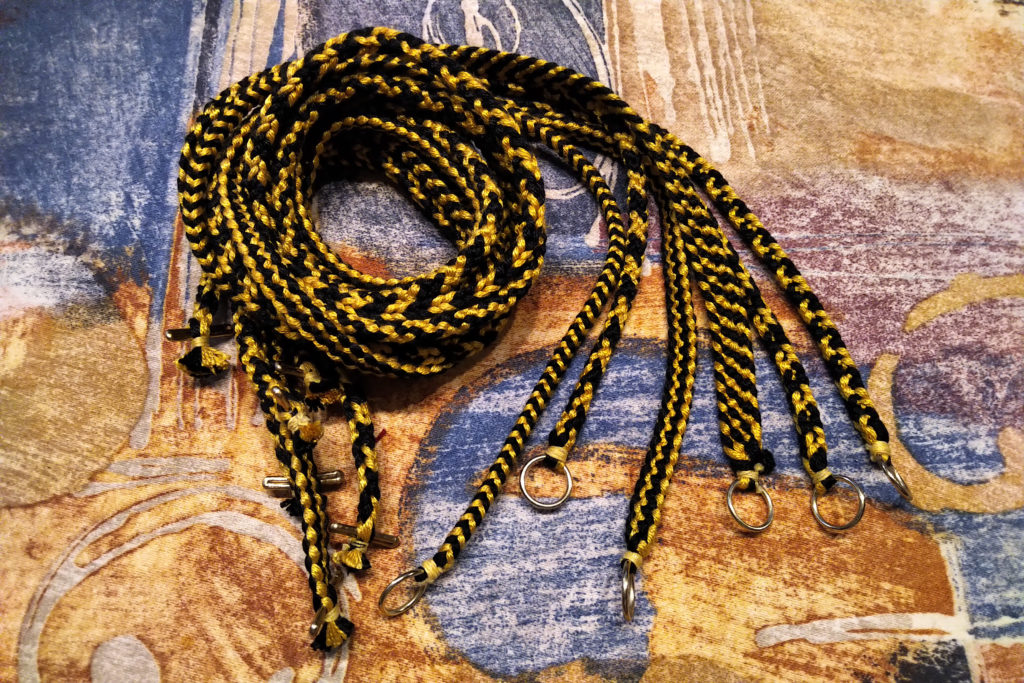
Normally, I try have a half dozen black and gold medallion cords braided by the time our local Agincourt event rolls around in October. This year, with everything else that was going on, I just managed to complete the sixth braid.

Barony Braids 2019

As usual, these are all about a yard long and all made from lace-weight silk yarn.