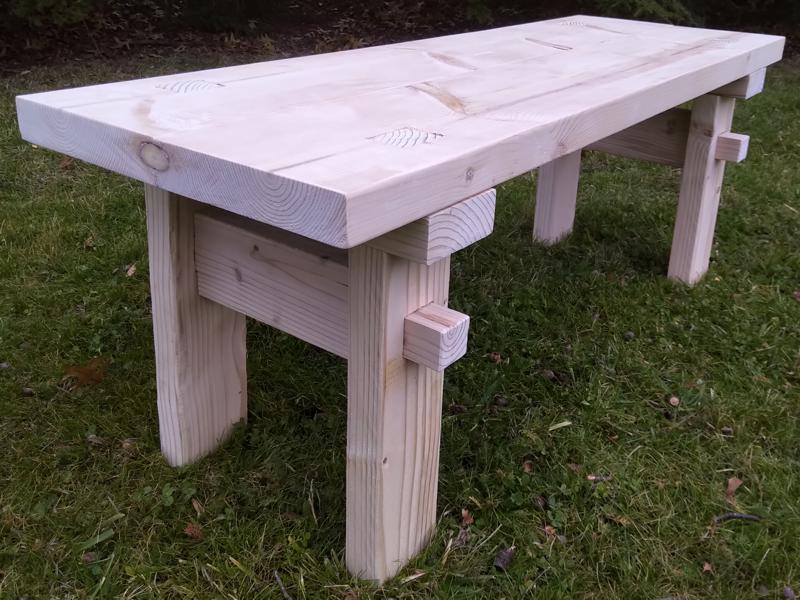
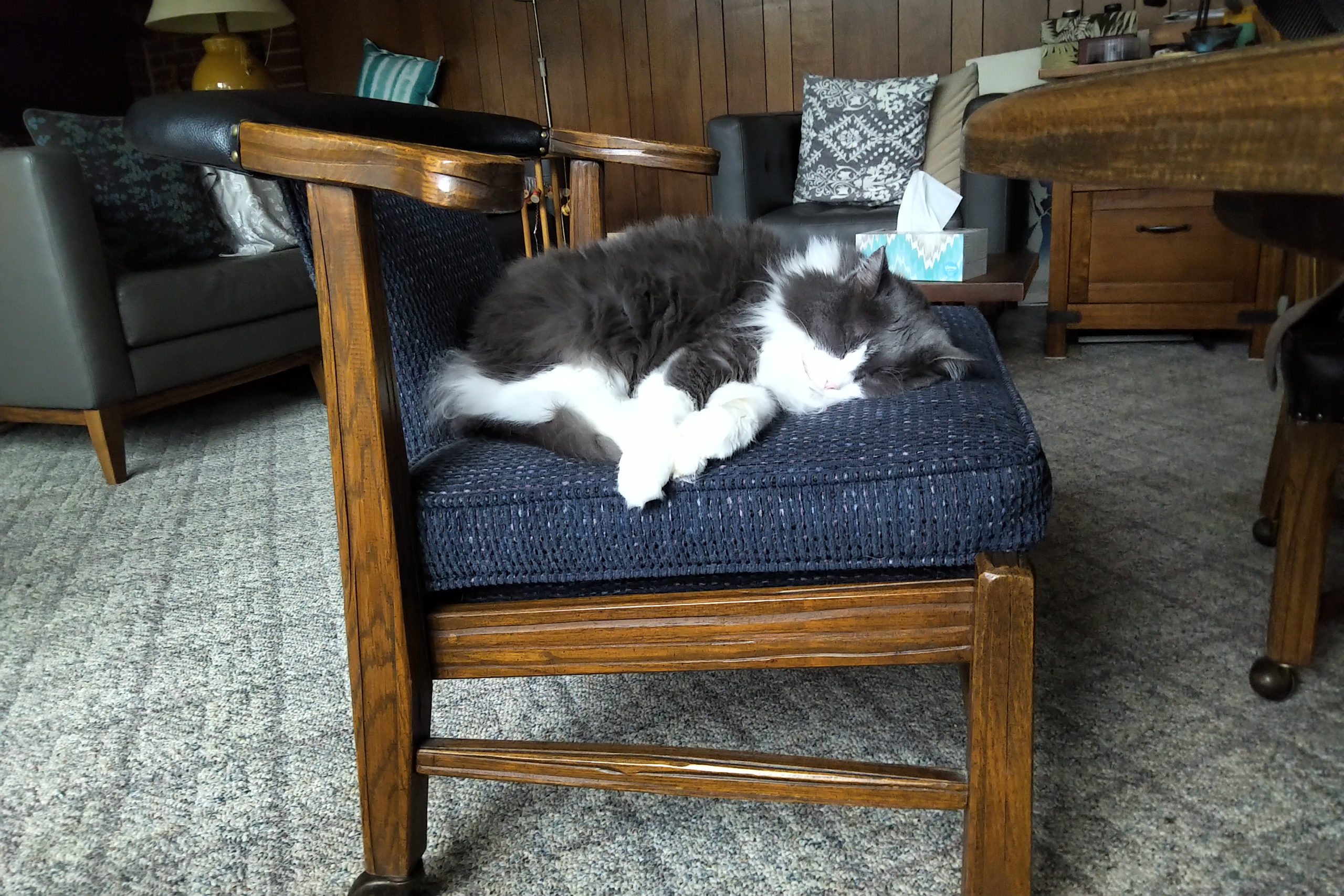
I managed to get all the joinery and tuning done on Friday, making this project complete. Here is the complete “Breakdown Bench”.
This is the completed and assembled bench.
It’s pretty solid, given how tight some of the joinery came out. It still comes apart, though. I need to sand some of these pieces a bit, and maybe add some sealer, but otherwise, it’s done.
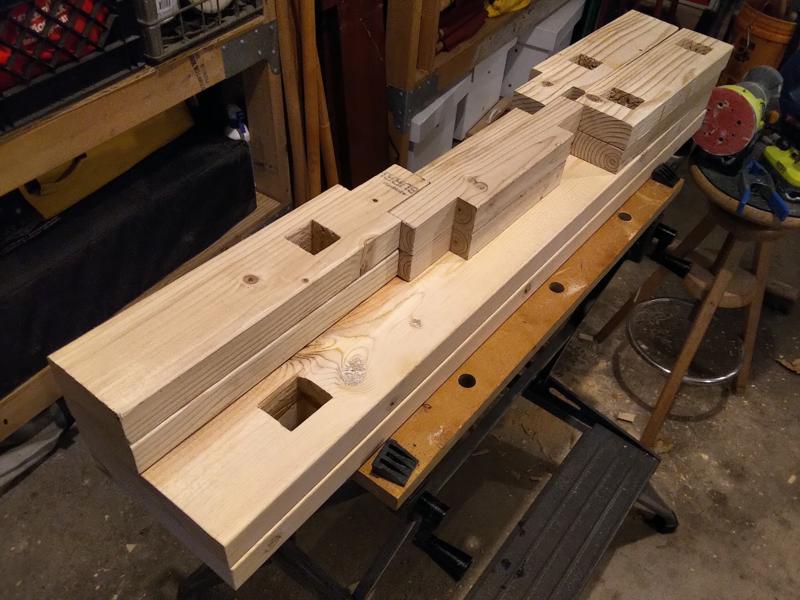
The completed bench, disassembled.
I wound up cutting the mortises on the benchtop pieces by drilling through and then cutting with a jig saw. This gave me the basic through- holes, then I tuned them with a rasp and a file.
I got started on this new bench project yesterday, and managed to make some real progress. Here is one complete set of legs for the breakdown bench.
One leg assembly consisting of two legs, one stretcher, and one support beam.
I have the other leg assembly mostly done, but one of my support beams broke apart, and I had to start over on it.
Even with the band saw for cutting tenons and the mortising machine, this kind of joinery is time-consuming work. Cutting the mortises in the benchtop pieces might be done some other way.
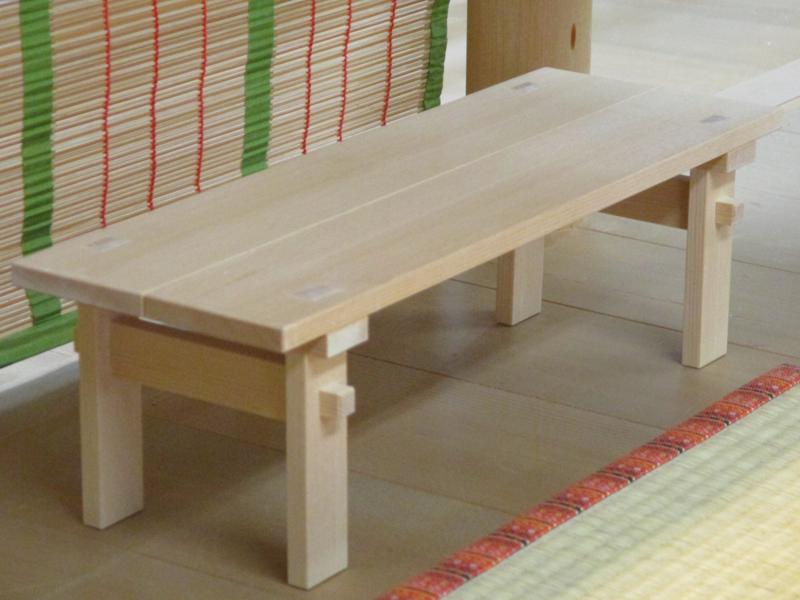
When we were recently in Japan, we visited the Costume Museum in Kyoto. There are only a few costumes on display in the costume museum these days. Now it is mostly a large dollhouse model of scenes from the Tale of Genji. Part of one of these scenes was this great little bench.
Model of a bench
So of course I decided that I need to make a bench just like this. The “no hardware” aspects of it really appeal to me, and even though it may turn out a bit unstable due to that, the ability to break it down into pieces for travel may come in handy. Also, since so many of these pieces have the approximate proportions of modern dimensional lumber, it shouldn’t be too hard to make.
Needless to say, it’s quite a bit of work to go from a photo of a scale model to a plan for cutting and joining actual lumber, but assumptions about scale, combined with measurements of actual lumber, can be used to make decisions, and create plans.
It’s not all fun and games here at the Booth/Evans household. Sometimes you have to do something boring and stupid like recaulk the tub.
The first step is to remove the old caulk. This reveals the secret of why the caulk is failing after only three years. The people who redid the bathroom skipped this step and just smeared new caulk over the existing dried-out old caulk. As part of the renovations, they also coated the ugly old tile with a white epoxy coating. This was also applied over the old caulk, and then caulked over to hide the fact. At least that’s a seal, but I had to be careful not to damage the epoxy coating when removing the caulk.
Anyway, here are the tools and supplies I used, lined up on the workbench.
Re-caulking tools
From right to left: A set of steel scraping tools that are very useful for removing hardened old caulk. Scrape-Rite plastic razor blades for removing softer caulk. A rubber squeegee for shaping the caulk bead once it has been applied. A utility knife for opening the tube of caulk. A small “squeeze by hand” tube of caulk, which costs almost as much as a full tube, but is just enough caulk for this task and needs no gun. A paint brush for sweeping away residue. A protective glove for keeping chemicals off my skin. A cotton rag and ultra-fine scrubby pad. A can of denatured alcohol for cleaning surfaces.
The set of scraping tools is probably the best and most useful thing I have ever bought at Harbor Freight. Thank heavens for the plastic razor blades. They are just hard enough to slice through silicone caulk, but soft enouch not to scratch the epoxy coating.
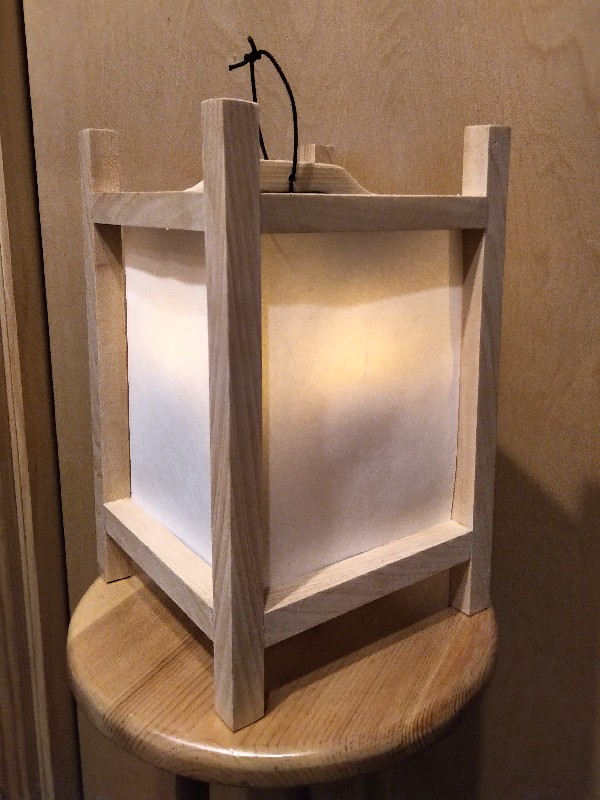
Got the pieces all cleaned up and glued together. Got the paper installed. Here it is with a battery-operated lantern inside:
A hanging Japanese style lantern made from cypress.
Getting that paper in there, reasonably smooth, and cut around the handle was a huge pain and took a couple of tries. It should look nice hanging in our camp gate at Pennsic.
I need to make a new hanging lantern for Pennsic, and I actually managed to spend some time out in the garage this weekend to get some of the bigger work done on this frame of the lantern.
It’s all left over cypress, joined with mortise and tenon joints. I cut the sticks on my band saw, smoothed them with a hand plane, cut them to length by hand, cut all the tenons on the router table, and cut all the mortises with a mortiser.
So, not a great example of hand work, but I might need to make a bunch of similar lanterns in the future, so I wanted to try to automate as much as possible. It still needs sanding, gluing, papering, and the insertion of some kind of light source.
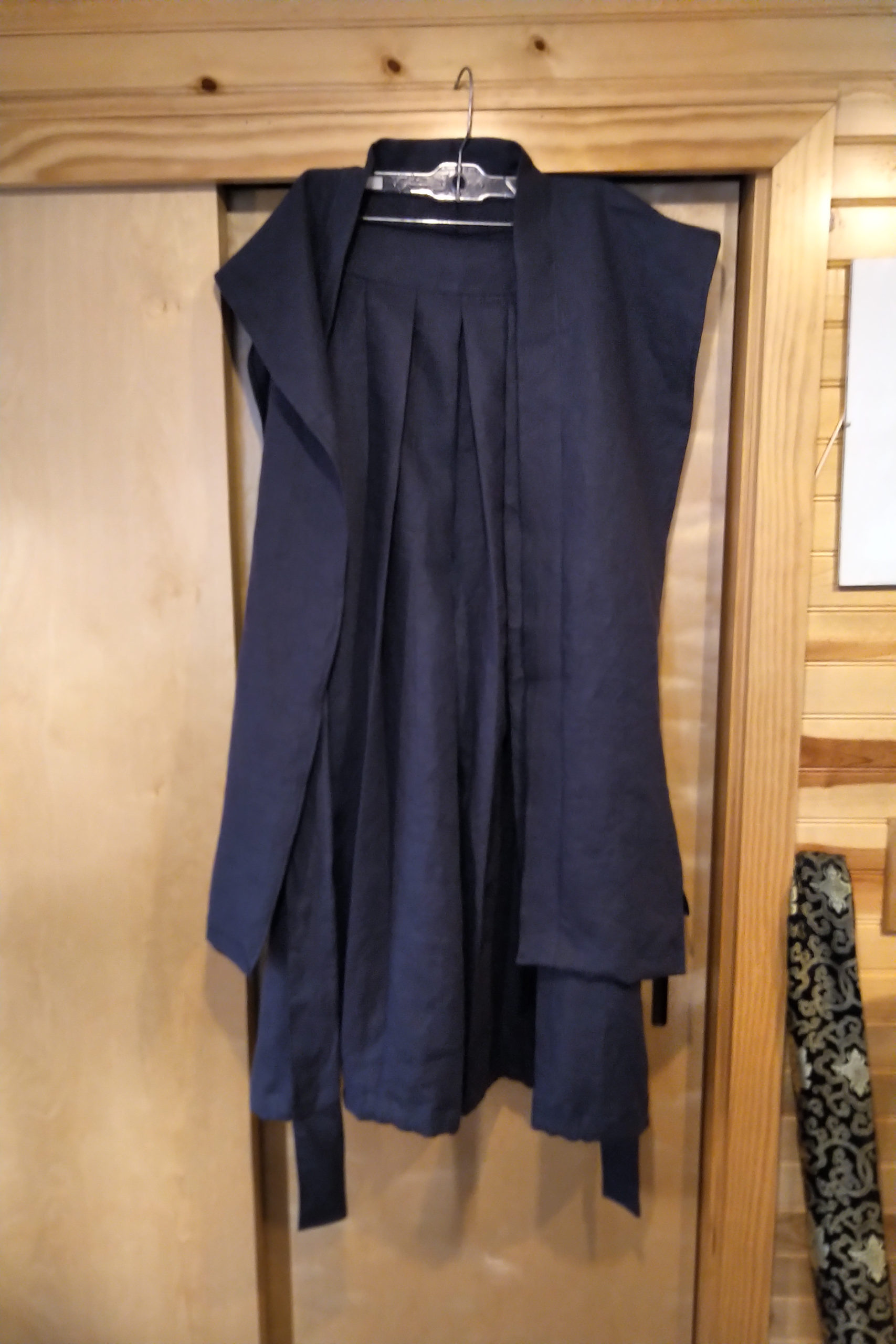
It has been a while (like, more than a year) since I made a basic medieval Japanese men’s garb outfit for myself, and my old stuff has started to look a little worn. So, I decided to make these hakama pants and kataginu vest out of some nice dark blue linen.
Hakama and Kataginu in Blue Linen
When the tops and bottom of an outfit are made from the same fabric, it is referred to as a kamishimo.
Sorry this photo just shows them hanging together on a hanger. I’ll try to wear them sometime soon and get a better photo.
It has become increasingly apparent to me over the past few years that, for this web site to survive as a continuing concern, I should restart my blog. Here it is. In spite of the proud tradition of outmoded technology exemplified by the rest of this web site however, this blog is a WordPress blog. Welcome.