bookmark_borderStool from Maple Board

My local Woodcraft location had some ambrosia maple cut-offs on sale for a reasonable price, so I picked up a ~5 foot long ~7″ by 1.5″ board and had to decide what to do with it. For the past few years, I’ve been thinking a lot about seating, so I decided to make a simple stool. Ishitani Furniture posted a video about making some 3-legged stools, and I thought about that, but I was not sure I had enough material for two stools. I decided to make one 4-legged stool.

I cut the board into two pieces. One 16″ piece I ripped into four leg pieces. I knocked the corners off those pieces with the intention of either using them as octagonal legs and later cutting tenons somehow, or turning them round. Then Chris Schwarz posted a video about turning tenoned chair legs on a lathe, and I decided to unpack the lathe and give it a try.

The legs came out about 1.375″ in diameter, with a 1″x2″ tenon turned on the end. Given that I am not super experienced at wood turning, and that this is the first time I have used the lathe in about 4 years, I think it went pretty well. They are not perfectly even, but the lathe makes everything perfectly round and smooth.

Next, I used a long, straight bit in the router to joint the edges of the board, then I used the same bit to cut a 1/2″ wide by 3/4″ deep slot into one edge of the board. I cut the board into two ~21″ long pieces, then cut a 1.5″ wide spline from some half-inch thick oak stock and used it to make a splined butt joint between the two pieces. I probably could have just glued the two edges together, but I wanted to try the splined joint, and the extra strength makes me feel better about sitting on the stool.

After letting the glue dry, I scraped off the squeeze-out and sanded it smooth. Then I pulled out a drilling guide and set it for ~10 degrees. I drew a 45 degree angle in from each corner, and clamped the drilling guide to the underside of the seat. I probably could have done this on the drill press, but I would have had to set up a jig to get a repeatable position on the seat. With the guide, I could align the guide to my pencil line, flush the corners of the guide with the edges of the board, clamp, and start drilling. I was using a 1″ Forstner bit to cut the mortises for the legs, so trying to do this by hand without a guide was not a good idea. Schwarz uses auger-tip spade bits for this job, but I hate spade bits with a passion, so that was out. Boring a 1″ hole at a 10 degree angle through a 1.5″ thick board was an athletic experience, but a little camellia oil in the hole kept the friction down so I was cutting and not burning my way through.

Then, I beveled the edges of the seat with a trim router. Normally, I soften the edges with a 1/8″ round-over, but I decided to go a little more angular and I’m really happy with the way it looks. The contrast between the angular seat and the round legs really works for me.

When I started to insert the leg tenons into the seat mortises, I realized it was going to be a very tight fit. I had thought that I would have to notch the tenons and wedge them into place, but as it was I needed to hammer them in and they are not coming out any time soon. Once the legs were in, I trimmed the tops of the tenons flush with the seat, and the bottoms of the legs parallel to the floor. Finally, a generous dosage of hemp oil finish.

That’s why you see it here in my drying cabinet/furnace room. I applied the oil before thoroughly reading the label and finding out that it takes a month to cure. All over but the waiting, I guess.

bookmark_border14th-century Japanese Toolchest Mark 3

I have been putting off the next step in this long-running experimental archaeology project more because I wanted to work on it at a particular event than because of my normal level of procrastination. I planed down the 1by lumber months ago, then I cut and assembled the chest at Aethelmearc War Practice. I started this project working on the Mark Zero “proof of concept” chest at War Practice back in 2018 or 2019.

Anyway, this is the fourth try at making a tool chest that looks like one you can see in the Kasuga Gongen Engi-e. This emaki illustrated scroll is from the 14th century and shows scenes from the history of a Kasuga shrine, including the shrine’s construction.

To better match the size and look of the Kasuga chest, I started with 1×6 lumber instead of the 1×8 I used on the Mark 2. It’s only about 39 inches long instead of the fifty-something inches of the Mark 2. I also used the thicker battens like I discussed, which I think worked out well.

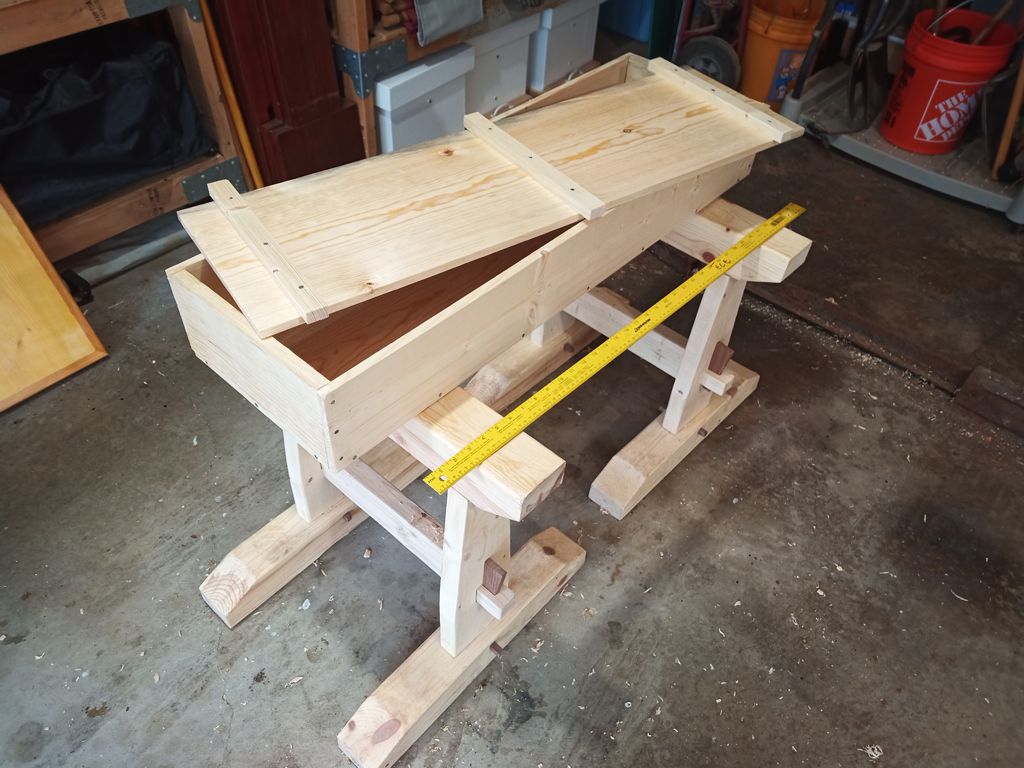
Here is what the four chests look like laid out in a row:

I think I really have the look now. The size an proportions may not be exactly right, but it’s pretty much there. I’ll maybe work on a few tweaks at some point in the future.

It’s long enough that I can get some of my longer saws in there, just deep enough that things don’t get buried under several layers, and still wide enough that some of my organizer tills fit in there sideways to keep things from sliding around.

bookmark_borderKarakusa Mousepads

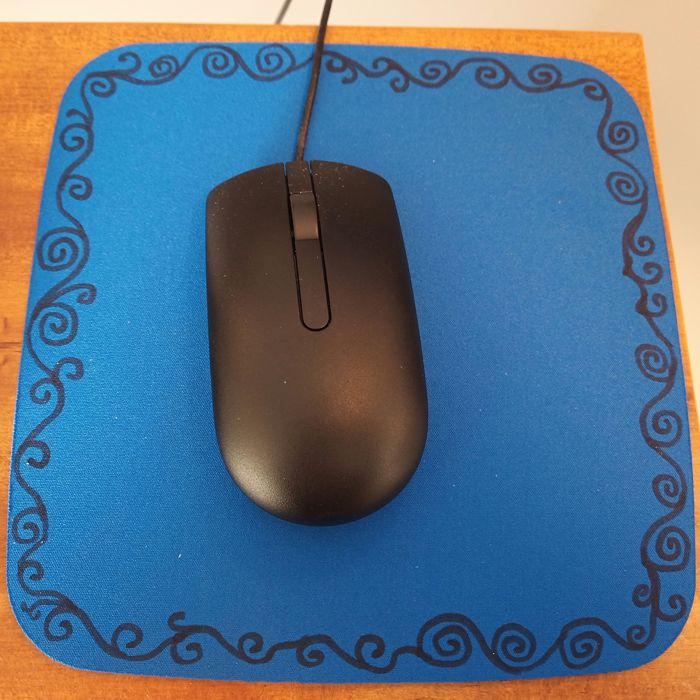
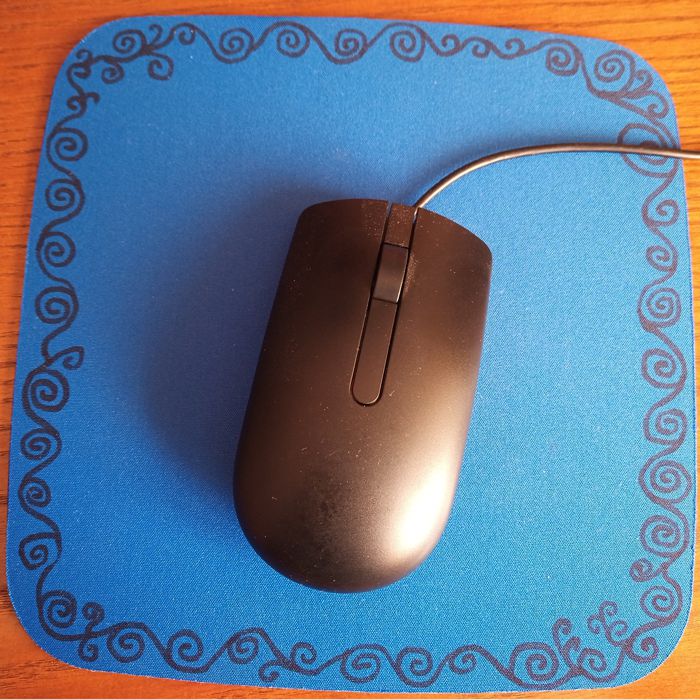
Although I have been working for my current company for almost three years, nobody ever gave me a mouse pad for either my desktop in the office or for the laptop I use to work from home. I went to the office store to buy mousepads, and they only come with generic graphics or in a small selection of solid colors. I guess nothing else really sells these days. Anyway, I wound up buying a 2-pack of royal blue mousepads. Because that was boring me, I took a marker and doodled some karakusa decorative vinework around he edges.

The one at work
The one at home

That’s better. I’m so glad that I taught myself how to do this for the Tachi Kake project.

bookmark_borderKaminari Sweatshirt

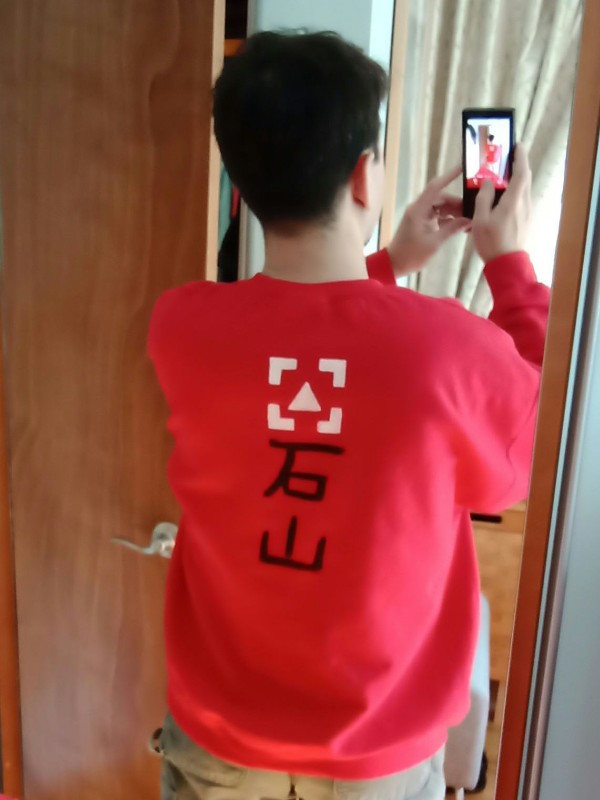
The motivations for this shirt are complex, but the execution was straightforward. I bought a blank red sweatshirt from the craft store, block-printed the Yama Kaminari clan mon in the center of the back and at the front left shoulder in white, then painted the kanji for my SCA name on the back beneath the mon. I had to re-paint the white by hand, which is almost always necessary when trying to paint white on dark color, but it’s pretty easy once the graphic is established. I used Jacquard Textile Color on this instead of heavier acrylic paint, since it soaks into the fabric more and changes the texture of the garment less. I’m really starting to like the Textile Color quite a lot.

Please forgive the mirror photo.
I love the Droste effect, don't you?
Re-mirrored so the kanji-enabled can read the name.

Anyway, this came in very handy on the chilly first night of War Practice this year, and on the chilly morning of pack-out at that same event.

bookmark_borderThird Takadai Braid

For my third takadai braid, I decided to both continue my progression through Rodrick Owen’s book, but go a little less dainty with the braid. Changing two variables at once is always risky, and this did lead to some regret.

Takadai rep braid in reeled silk thread

It is about five feet long. The tension is inconsistent so the width varies, but it’s about 1.125″ wide and 0.375″ thick. Heavy.

The structure is called a “rep braid”. Each time you open a shed, 3 bobbins pass through it. This creates the big knobbly stitches and thickness.

I used 16 ends of reeled-silk thread per tama, and this braid is done with 43 tama. I used the new 100-gram tama that Sweetie gave me as a present.

I think that I was not beating hard enough at the beginning, and I was beating too hard at the end. I guess this will get more consistent with practice. If I did this with half as many ends per tama, it probably would be easier.

bookmark_borderCoronation Braids, Spring A.S. 47

Our SCA Kingdom, the Sylvan Kingdom of Aethelmearc, had its Spring Coronation last weekend, so I made some braided medallion cords for the Baronial gift basket to the Crown.

Six silk medallion cords in red and white

I was a little short of time, having entered the six 16-tama braids I made in the fall into a largess derby in January, so I did mostly 8-tama braids. One of the braids is the 16-tama double-rai braid, four are yatsu se, and one is shige uchi. I should do a batch of the 9-tama shige uchi braid next time.

bookmark_borderBanner for Hara Kikumatsu

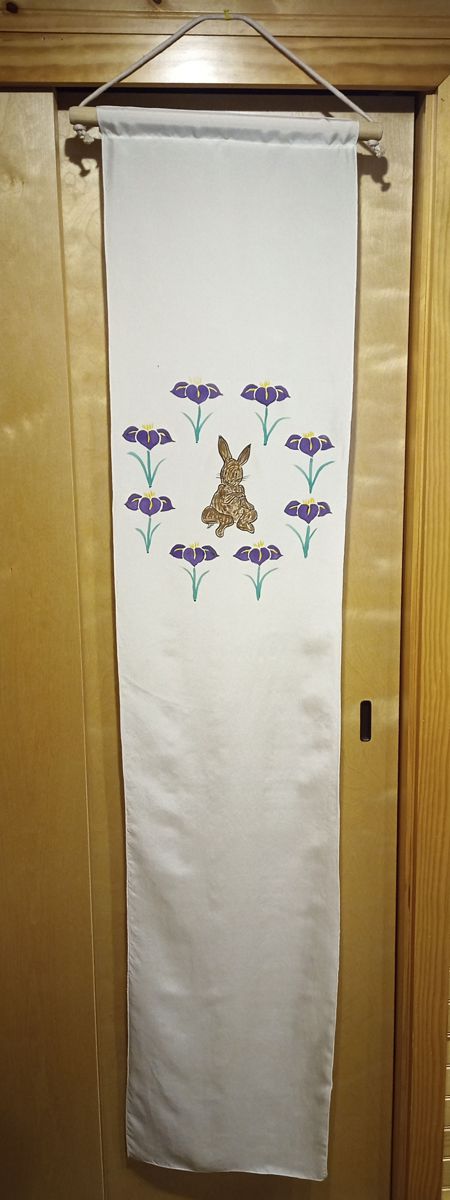
My sweetie answers her writ to the Order of the Laurel tomorrow. Here is the silk banner I made for her!

Argent, a brown rabbit sejant affronty proper within eight irises in annulo purpure slipped and leaved vert

This banner is made with “Dye-na-flow” paint on habotai silk. I pre-treated the silk with “No-Flow” sizing to make it react to ink more like paper than fabric, so I could just trace the artwork as if it was an illustrated scroll. I’ve had mixed results with this method, but I think it came out wonderful this time around. The suspensory braid is a 16-strand braid in white silk, actually a length of braid left over from Duchess Sir Morgen’s elevation garb.

bookmark_borderToken Braids

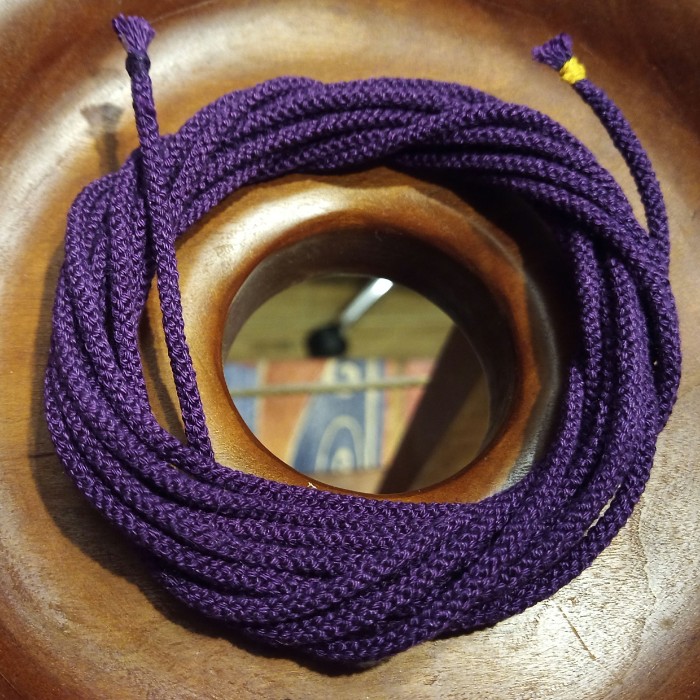
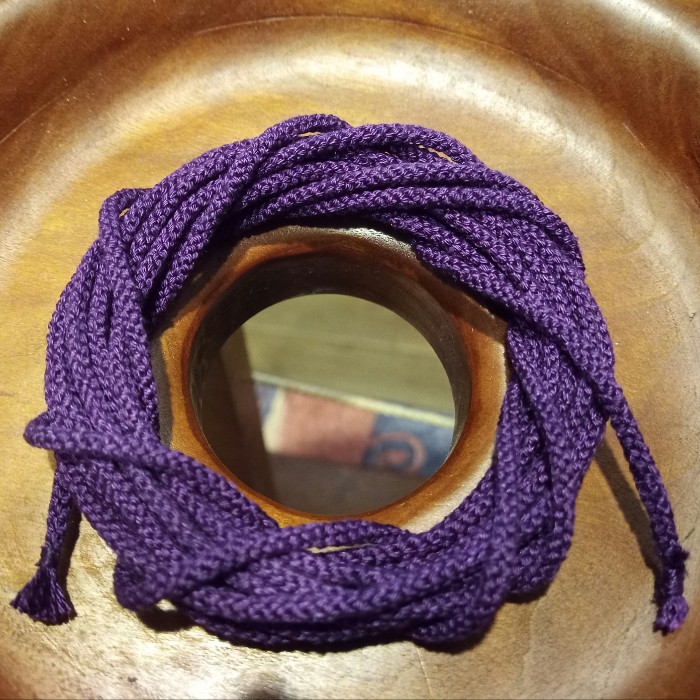
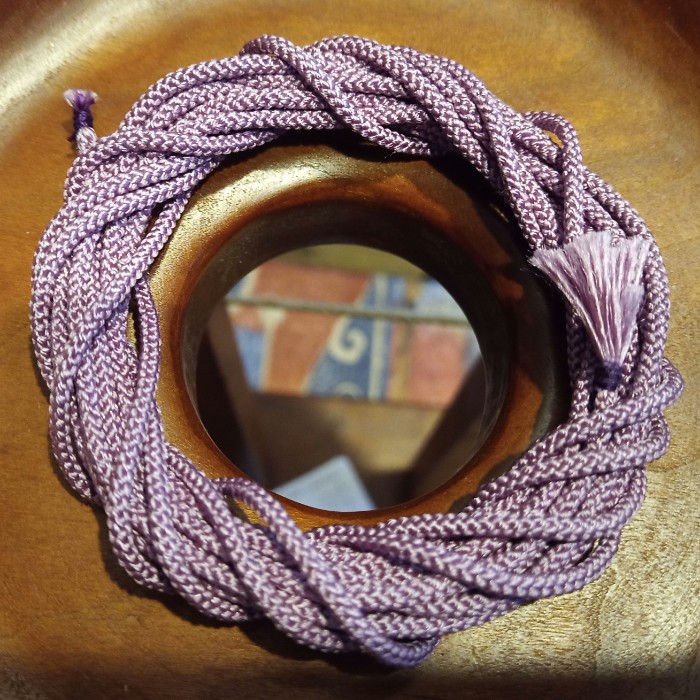
Sweetie needs some braids to make tokens for her elevation later this month, so I spent a few weeks doing nothing (braiding-wise) besides edo yatsu in silk.

Edo Yatsu in violet silk
Edo Yatsu in lilac silk

These are all 8-strand “round” braids about an eighth of an inch in diameter. The violet braids use lace-weight silk yarn, but the lilac braids use reeled-silk. This fine filament silk is a bear to work with, especially in bulk lengths like this. Each braid is about four yards long, starting from about five yards of material.

bookmark_borderIf this review exists, you are in the wrong universe

Last night, I finished reading the latest book in Jason “David Wong” Pargin‘s “John Dies at the End” series, If This Book Exists, You’re in the Wrong Universe. I liked it quite a bit.

This series, if you can find it in a store, typically gets shelved under “Horror”, but I don’t know. I found out about the first book while trying to watch all of the movies directed by Don Coscarelli. He mostly directs horror movies like Phantasm and Bubba Ho Tep, so I guess that makes the book that the horror movie was based on a horror book. There is plenty of horror in it, but it’s also very funny because there is plenty of humor in it, but it’s not a comedy because there is a good solid serious story under those other layers.

The thing about these books is that each one is better than the last. The horror is more involved. The humor is more pervasive and integrated. The story and the development of the characters is stronger, more personal, and more positive (no, really).

Interspersed with all the bloodshed and explosions, with all the running gags and one-liners, there is some intricate plotting and utterly awesome prose. I read some passages out loud to Sharon because I was just stunned by some of the wonderful things Pargin writes for his characters.

You don’ have to read all the books in order to appreciate any one of them. If you don’t think you have the patience to “get all caught up”, I say don’t bother. Jump straight to this last one even though it will spoil the shock that John doesn’t die at the end of the first one. It’s definitely the best of the series so far.