bookmark_borderBeaded Fancy Braid

The braid I used for Fancy Square Braid and Another Fancy Braid has these nice compressed inner threads, and it struck me that you could make those inner threads beaded, and the beads would be nicely couched in the braid. I had some “magatama” beads in my stash from the swag bag of the AKS conference in 2017, so I decided to try it.
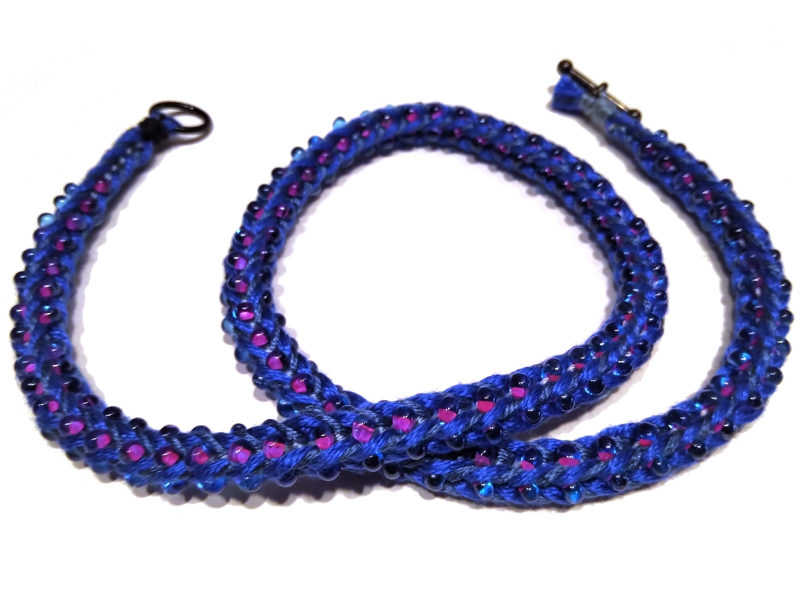
Fancy Braid with Beads completed 2021.11.08

I really like how it came out. There are a couple of “errors” in it, but I mostly recovered from them quickly so the overall braid was not disrupted. The magenta inner core on each bead makes a nice counterpoint to the different colors of blue thread I used for the other strands. The beads are strung on “S-Lon” beading cord, were kind of a challenge to get them well seated in their stitches, but I was able to work out a method eventually. The “magatama” beads have a teardrop shape, and are only on every other side stitch, which made it somewhat easier.

bookmark_borderAnother Fancy Braid

I was going to participate in a zoom conference with a bunch of braiders, but I realized that I did not have a braid set up to work on during the call. so, I measured out the silk, wound the tama, and worked on the braid. Then, I had another Zoom, and that gave me enough time to finish the braid.

It’s basically the same braid as the previous one, but the core and outer colors are reversed.

bookmark_borderFancy Square Braid

This braid is braid 16AD, the final braiding pattern, in Jacqui Carey’s book “Creative Kumihimo”. Essentially, it is a 12-strand braid that is overlapped with a 4-strand braid. I used it to create this braid which uses Baronial colors at the corners to protect a tight inner core of Kingdom colors.

The completed braid is about 30 inches long, with a ring-and-toggle closure so that it can be used as a medallion cord. Each strand of the 16 contains 6 ends of lace-weight silk yarn.

bookmark_borderBox for 4×6 Index Cards

I use index cards for a lot of things. I used to have a printer that would accept 3×5 cards on manual feed, so I’d print out all kinds of useful information onto cards for handy reference. I even made a box to hold printed and blank 3×5 cards on my desk so that I’d always have them within easy reach. That printer is long gone, and my current printer will only take things as small as 4×6 cards. So, it was time for a new box.

Full 4×6 Box

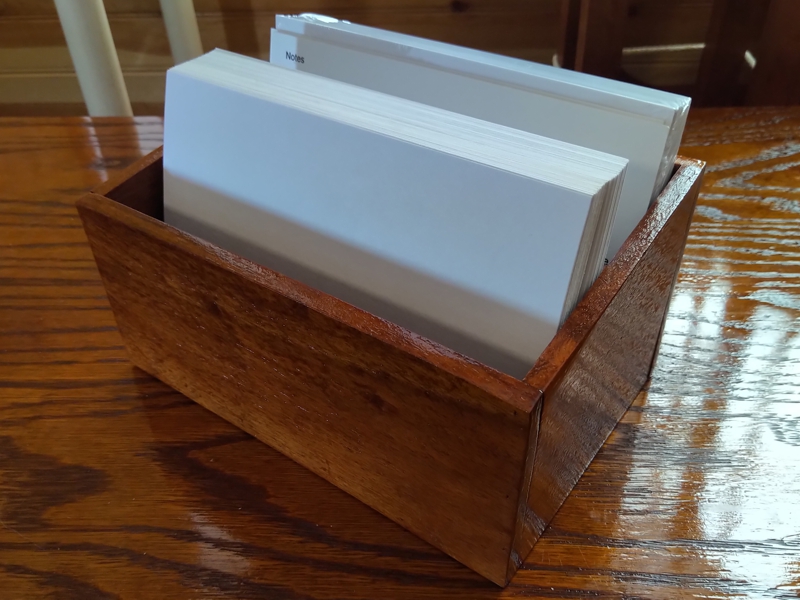
A friend gave me some thin wood scants, I think they might be mahogany, and I had enough to make this box. There is no fancy joinery, it’s all held together with glue and 23-gauge pins. There is even a divider down the center to keep the clean cards separate from the used ones.

Empty 4×6 Box

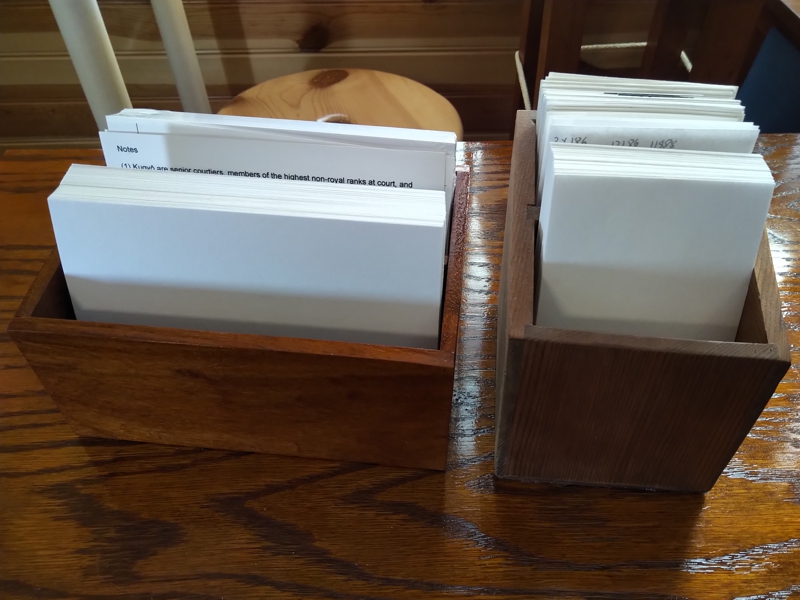
It is finished with a couple coats of blonde shellac, which really brightens up the wood color and gives it some polish. I put some cork squares on the underside so that it won’t scratch up my desk. You might notice that it holds the cards in landscape orientation. Given the shapes of the wood pieces I had, it was actually more economical to do it this way than portrait. The 3×5 box was portrait, and made from cedar.

4×6 and 3×5 Boxes Compared

bookmark_borderStill Braiding

I am still braiding with kumihimo on a regular basis, though not as much as I used to. Most of my braids become medallion cords that are donated to my local SCA group. Some become garb embellishments. every once in a while I just do a braid to practice a particular braid or color combination. Also, sometimes for fun. This one is basically for fun, to break up the monotony of making black&gold braids for the Barony or red&white braids for the Kingdom.

Completed 2021.10.31

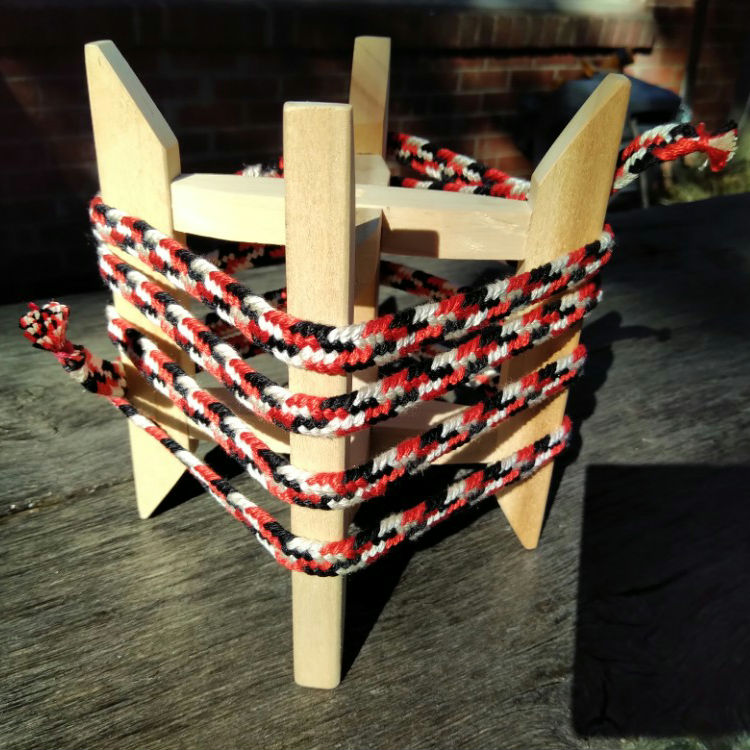
This braid is about 6 feet long. It is a 9-strand flat braid that uses 6 ends of lace-weight silk yarn per strand. This braid is a little short for it, but it is appropriate for use as a sageo or simply securing a box. To achieve this color pattern in the final braid, I started with a RKK WK RW WR set-up.

The Set-Up

bookmark_borderArtisanal Brushwork Five

This is the second of a pair of recent replications of images from the Nanajuichiban Shokunin Uta-awase emaki, a medieval Japanese scroll that depicts an imaginary poetry competition between artisans and artists of various types.

Nanjuichiban Taiko Shokunin 01

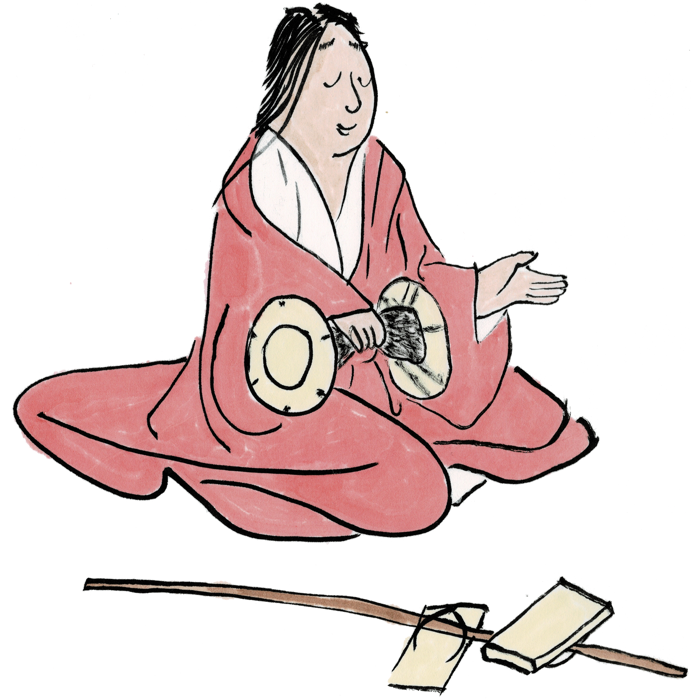
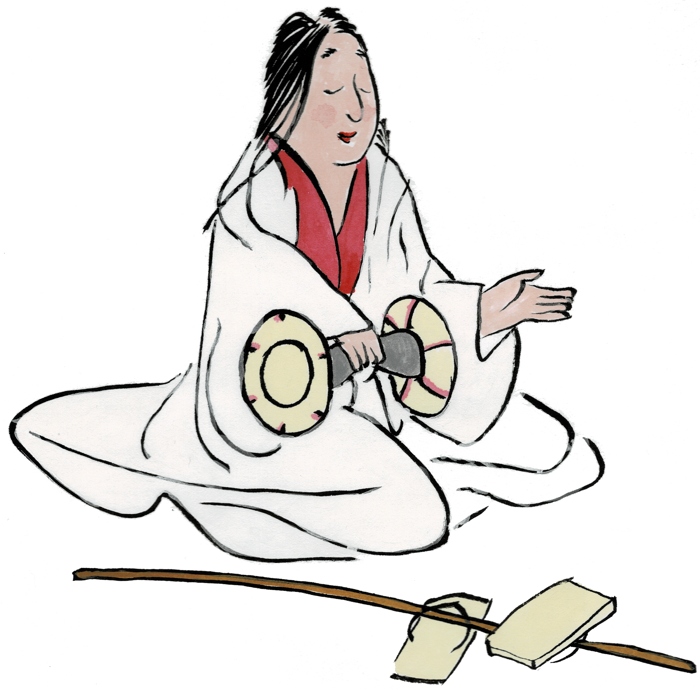
This emaki (illustrated scroll) depicts a poetry competition (uta-awase) among people of various occupations. The competition has 71 rounds, and 142 different kinds of craftspeople (shokunin) are depicted, each with their own poem. This image depicts a musician playing a small drum called a “ko-tzuzumi”, The heads of the drum are tensioned with rope. As she is depicted with a walking stick and zori sandals, she is most likely an itinerant musician.

Nanjuichiban Taiko Shokunin 02

I’m happier with the second copy, though realistic depictis of the drum appear to be somewhat beyond me. I’m intrigued by the thing where both this lady and the biwa player thread the walking stick through the straps of their sandals.

[Ishiyama‘s Yamato-e page has been updated to include all the paintings to date.]

bookmark_borderArtisanal Brushwork Four

This is the first of a pair of recent replications of images from the Nanajuichiban Shokunin Uta-awase emaki, a medieval Japanese scroll that depicts an imaginary poetry competition between artisans and artists of various types.

Nanjuichiban Biwa Shokunin 01

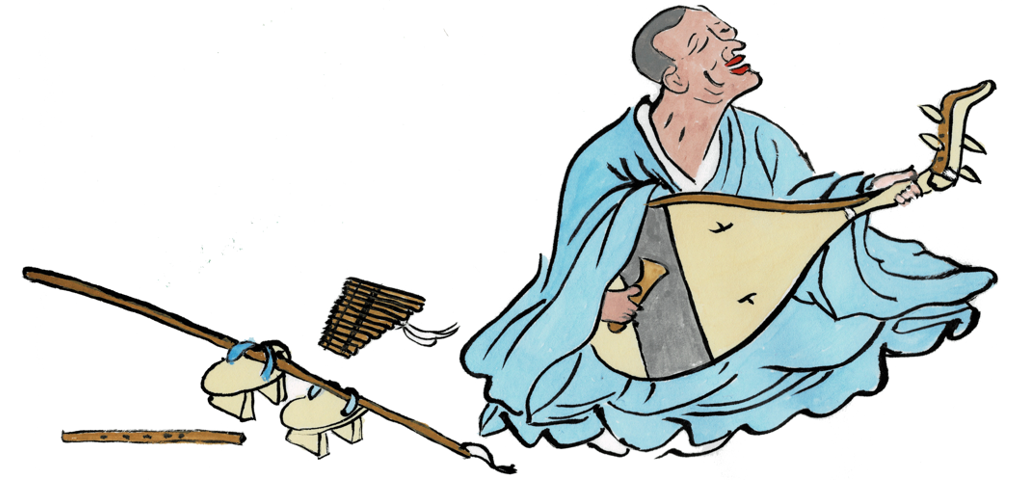
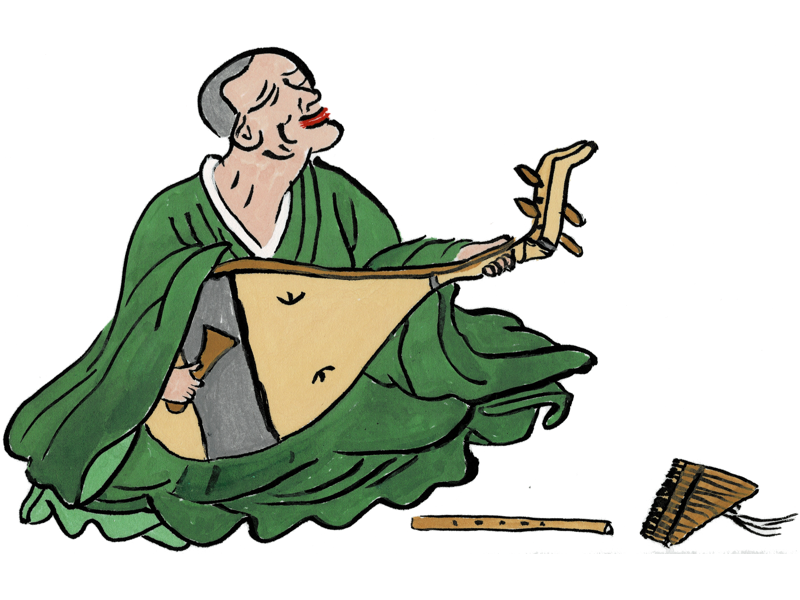
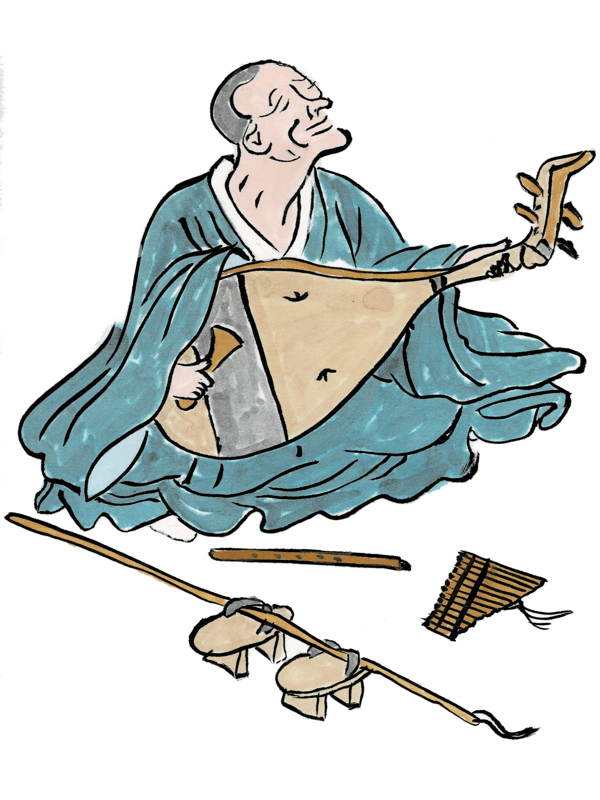
This emaki (illustrated scroll) depicts a poetry competition (uta-awase) among people of various occupations. The competition has 71 rounds, and 142 different kinds of craftspeople (shokunin) are depicted, each with their own poem. This image depicts a musician playing a stringed instrument called a “Biwa”, the strings are plucked with a fan-shaped plectrum. As he is depicted with a walking stick and geta sandals, he is most likely an itinerant musician.

Nanjuichiban Biwa Shokunin 02

You can see that I did a little bit of playing with color and composition, particularly the arrangement of the musician’s accoutrement. The first one is most true to the original scroll, but I like the way the green coloring came out on the second copy.

bookmark_borderHere’s That Pelican Brushwork

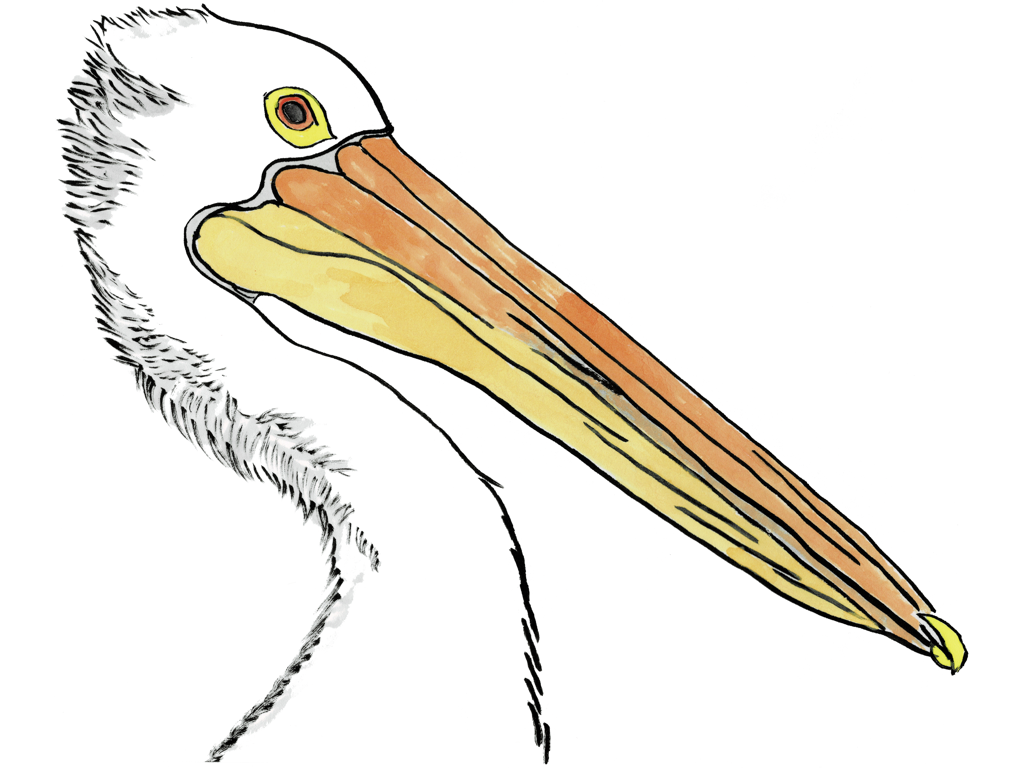
Here we go with that first pelican image I was talking about last week. I did four copies of this one. The first one is quite large, occupying most of a sheet of 9″x12″ paper.

Pelican 01 01

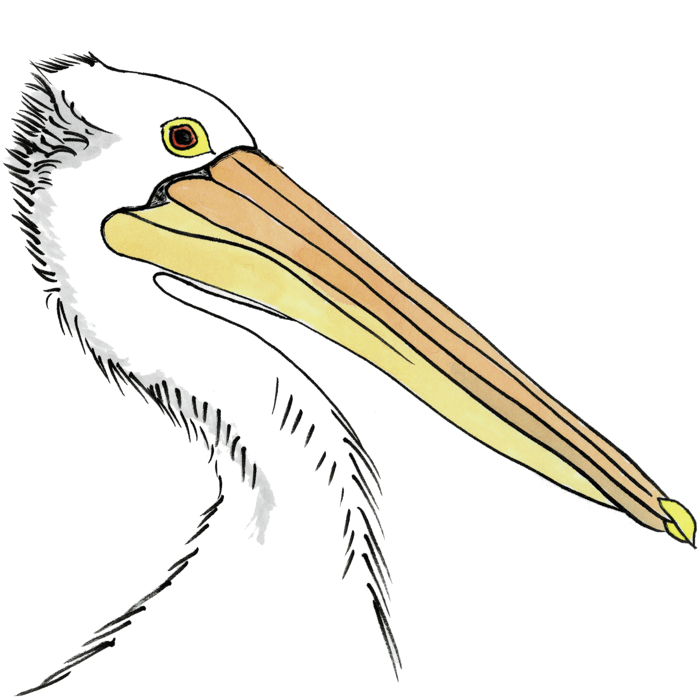
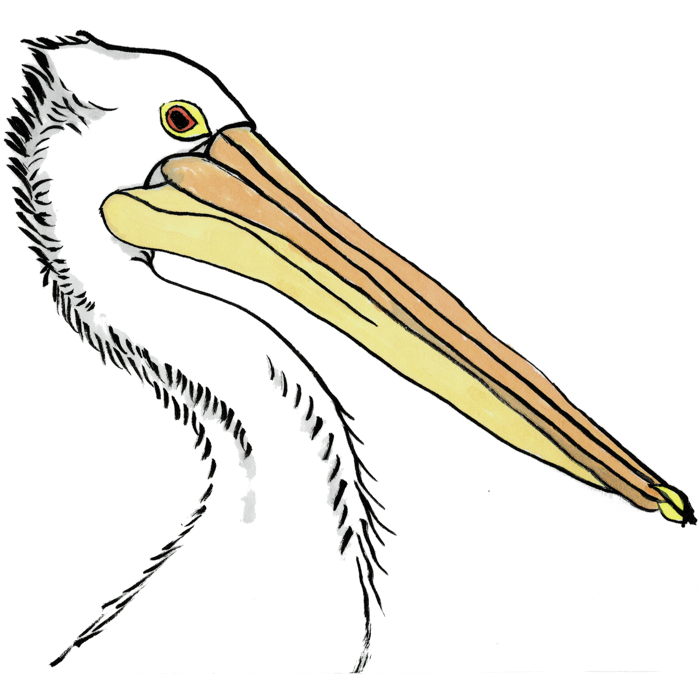
The others are smaller, to leave more room on the page for writing.

Pelican 01 03
Pelican 01 04

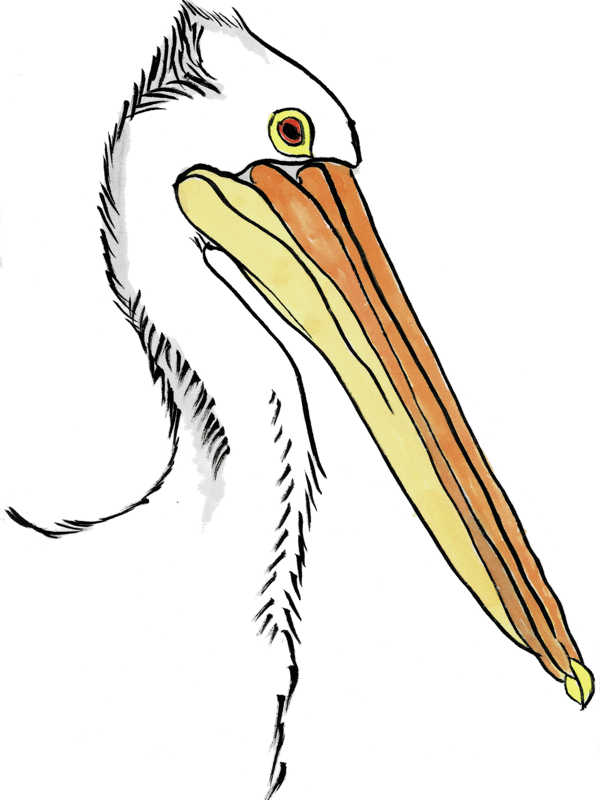
This last one I rotated a bit to make it occupy even less of the page.

Pelican 01 02

Traced from “Pelikan” by Christoph Schaarschmidt (2021). This photo was one of the top 50 photos in the CEWE photo awards competition of 2021. I saw this photograph of a pelican, and just thought it would make a good writ scroll or other recognition of service. The dignity of this noble bird shows through, as does the dignity of those who perform service in the society. I traced the photo and colored it in the “tsukuri-e” (built up paint) style.

bookmark_borderStamp Card

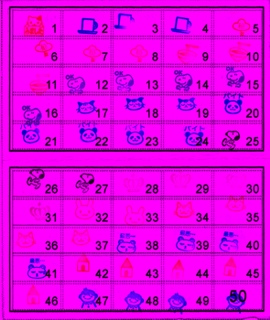
At the Tokyo Japanese Store here in Pittsburgh, where I get most of my Japanese groceries, they give you a stamp on your stamp card for every ten dollars in merchandise you buy. When you get 50 stamps, it’s a $10 coupon for the store. That’s only a 2% rebate on groceries, but everybody knows the real value comes from collecting the cute little stamps they use. They change them out every week, and must have a huge box full of hundreds of them at home. Here’s one I completed earlier this year, but did not want to use until I got a scan of it.

Stamp Card

Please don’t use this image to get $10 off Japanese groceries.